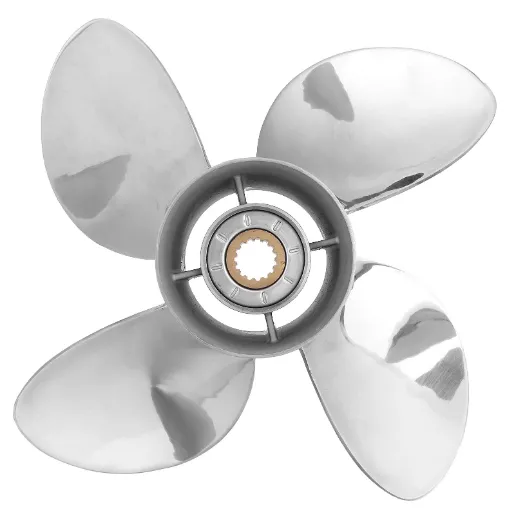
Choosing the correct propeller for your outboard can be dreadful to the degree that it can make or break your motorboat’s overall performance, fuel usage, and experience of boating. Different types, materials, and designs can make choosing the best-fit propeller for their needs no easy task. Hence the purpose of this text guide is to help uncomplicate and give detailed insight into the process to help you in making an assessment. Take a rollercoaster of useful examples of what is actually needed in boosting speed while cruising or decreasing fuel use and determine what is best out of them to make the correct choice for buying new propeller for your vessel.
Understanding Outboard Propellers
What is an Outboard Propeller?
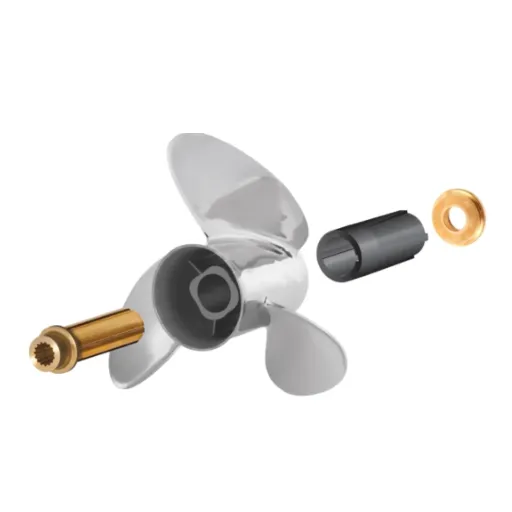
A boat propeller is a mechanical device that is used to propel a boat through the water by converting the power generated by its engine into thrust, and consequently moving the boat forward or backward. The propeller is made of or punctuated by blades that rotate on a central hub, generating a difference in pressure in the water and pushing itself; in this way, the vessel is pushed along its course with force and efficiency.
The size, the pitch, and the material from which a propeller is made are important parameters when it comes to the propeller going about one of its various possible local behaviors. The size is the diameter of the circle that is formed by the tips of the blades in rotation, while the pitch is the amount the propeller would theoretically move forward in one full rotation. The common materials used in propeller construction include aluminum and steel, as these strike a balance between durability and low weight.
Key Insight: Selecting the perfect propeller for your outboard engine is instrumental in maintaining your boat’s optimum fuel efficiency, speed, and overall handling. Having a well-designed matching propeller for your outboard ensures that your engine runs within its recommended RPM range and doesn’t over-color its mechanical parts. Your knowledge about how the outboard propeller works and the precise selection of it can enhance your marine tourism experience itself.
Types of Outboard Propellers: 3-Blade vs. 4-Blade
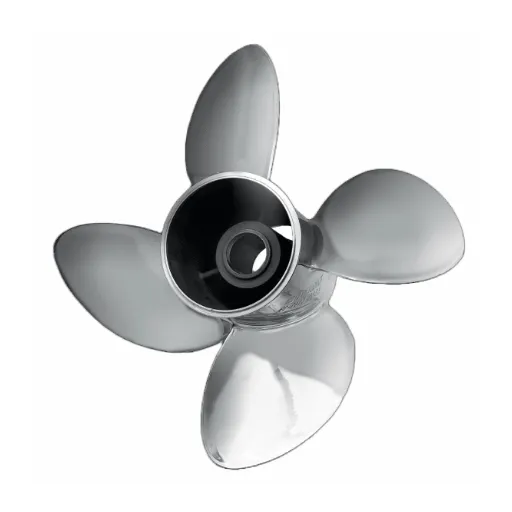
Three-blade propellers are relatively faster and less expensive, whereas four-blade propellers offer better stability, acceleration, and less vibration.
The Role of Pitch and Diameter in Propeller Performance
The pitch and diameter are two key aspects that directly affect the performance of a propeller and the efficiency of the vessel. The pitch will identify how far the propeller should travel in one full rotation, unslipped. High pitch is needed for fast speeds and will require more motor power. Lower pitch is good for acceleration and heavy loads. The right pitch-leveling operation of the engine, with respect to the engine speed so that the engine is never over-loaded, thus reducing efficiency and minimizing wearing of the engine.
The entire width of the circle that the propeller’s blades create as they rotate is known as diameter. Large-diameter propellers are the most suitable propeller types for boats that prefer rough waters or carry large loads because they provide the most thrust. On the contrary, the smaller-diameter propellers are meant for very fast boats carrying lighter loads where the speed is the main objective. A proper combination of diameter and pitch is required if you are to balance performance as needed.
Important Note: An inversely proportional connection exists between pitch and diameter, for if one is increased, the other preferably has to be reduced. For instance, increasing the pitch would require reducing diameter to prevent overloading the engine. It’s good for you to understand this in order to choose a propeller that best serves the requirements of your boating conditions: effortless handling, improved fuel economy, and overall better boating performance. It is always a smart decision to listen to the boat or engine manufacturer for guidance on any new propeller purchase so you can get the best results.
Propeller Materials: Aluminum vs. Stainless Steel

Advantages and Disadvantages of Aluminum Propellers
✓ Benefits of Aluminum Propellers:
- ✓
Cheapness: One of the central drawcards for aluminum propellers is that they are less costly when looked at from the perspective of their counterparts in stainless form; clearly a thrift-sensitive choice for most boat owners. - ✓
Lightweight: Being lighter-weight, they’re easy to work with and install without heavy strain on maintenance or replacements. - ✓
Largely Available: Aluminum props are usually found in a wide range of different sizes and designs so as not to be difficult to adapt when considering a wide range of boat types and motors. - ✓
Almost Immune to Freshwater Corrosion: A barnacle or two never matters. Aluminum is fine in freshwater surroundings and does not rust easily so it provides the strength needed without the expensive coatings or dipping. - ✓
Ding Repair-Friendly: Sometimes fixing an aluminum prop is easier and cheaper than fixing a stainless steel prop.
✗ Cons of Aluminum Props:
- ✗
Less Durability: Aluminum props bear more damage from impacts, bending or chipping than do their stainless steel counterparts. - ✗
Fairly Low Efficiency at High Speeds: The propeller can easily get distorted while carrying out high loading, or running at high speeds in water, whereas the capacity for technicality diminishes, itself bringing more fuel consumption and less efficiency. - ✗
Cannot do well in the corrosive atmosphere of saltwater: Aluminum material propellers are prone to rust more quickly in conditions that are salt corrosive; proper maintenance of the propeller is required. - ✗
Generally not for high performances: Aluminum is not the most desired choice in propellers when it is about maximum level power; thrust, pushing through waters to complete races, etc., demands a final choice of materials. - ✗
Not a perfect ride: When forced to stay too long under the sun, aluminum loses its spine, hence some fading and softening, becoming less reliable.
Why Choose Stainless Steel for Your Outboard Propeller?
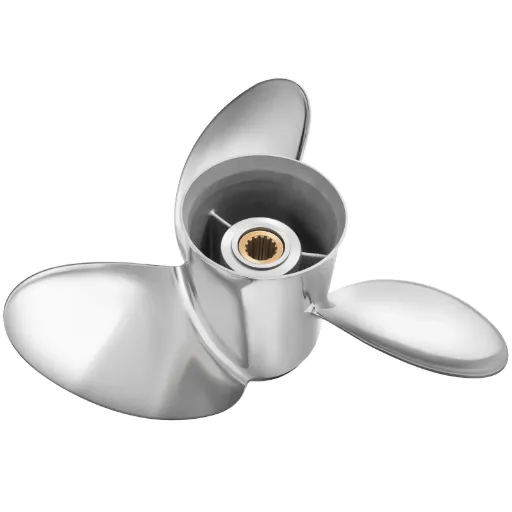
Stainless-steel propellers are considered the crème de la crème for outboard propulsion, bestowing power, thrust, and longevity altogether. As far as corrosion is concerned, the stainless-steel propellers are a better bet against their aluminum counterparts, which gives them an edge, both in freshwater and hot saline water environments. And its enormous resistance to wear means that it is capable of handling stress and shocks better in performance-critical applications. They are simply awesome for handling rough waters.
Another advantage of stainless-steel propellers is fuel efficiency. The rigid blade designs, with only slight changes in blade thickness, can be engineered more precisely, enhancing hydrodynamics and performance efficiency. This advantage specifically translates to an increase in acceleration, super response in handling, and increased speed. Plus, because stainless steel is so robust that under most conditions, skegs will remain intact and maintain their shape; it ensures consistent performance all throughout.
Bottom Line: Finally, though initial aluminum costs may be lower, the superior stainless steel propellers’ durability and performance may indeed turn them into a more cost-efficient investment. For boat owners looking for reliability, performance, and longevity in one package, stainless steel is the right material.
Cost Considerations and Durability Comparison
In choosing this or that propeller material, you must consider both the initial cost and future savings. Comparatively, stainless steel propellers are always costlier at the start than aluminum propellers, this being because they are difficult to break but less easy to manufacture. Aluminum propellers may break easier and are more cost-effective upfront. Aluminum propellers may break rather faster as they are subject to damage like dings, bends and even breaks as you navigate through hard or garbage-filled waters.
Durability represents a major point of contrast between the metallic materials. Since stainless steel is tough by nature, it is often more capable of receiving a more significant impact before it can break in comparison to aluminum, which is susceptible to damage from the slightest of bumps. It is thus a good choice for those who plan to use it in shallow, turbid waters. Another good schooling aspect would be the fact that this metal is highly resistant to corrosion and hence presents a savior in marine environments, where exposure to saltwater can entirely spoil weaker materials such as aluminum with a quick burnout. Provided it is crafted with stainless steel, an obvious win to the durability sector would be the chance of long-spaced maintenance procedures sans frequent repairs and changes, which then equates to sailing comfort no matter how bad the waters are for boaters who usually sail in regions with extreme environmental conditions.
While aluminum propellers might fall short in terms of cost effectiveness at first sight, the cost analysis view changes down the road. Stainless steel propellers boast high longevity, higher performance, and low maintenance or servicing requirements, allowing them to greatly reduce total lifetime costs; therefore, the initial outlay on stainless steel seems worth the high cost. Longer-term investment and high performance would make stainless steel propellers one of the most economically preferable blades in comparison to aluminum propellers following initial price discrepancies.
Propeller Maintenance Tips for Longevity
Regular Inspection and Cleaning Procedures
Regular inspection and cleaning to prolong the life of your propeller and maintain its consistent performance. Begin an inspection to look at visible scrapes, gouges, or cracks to detect damage. Such clutters will bring about less efficient propeller performance, and further ills can be traced to it. Look into any strands of fishing lines and pieces of debris wrapped up either directly on the propeller shaft or piled up in between the propeller and the gear housing. All the same, those would cause the motor or its associated internal parts to suffer.
Propeller cleaning properly implies cleaning off gradually thick buildup of dirt but also with seaweed and barnacles. Use a brush of medium to the softest touch and be restricted in matte black finishes (stainless steel or aluminum that has been coated). A nice rinse with freshwater cleans off the salt and chemical residue that may remain.
⚠️ Maintenance Schedule Recommendation:
Do these procedures on boats in freshwater areas or saltwater regions after each use, and every other regular boat trip. Periodic upkeep does not only ensure maximized performance but also reveals any issues at an early stage and cuts the gigantic resulting costs while saving you all repair expenses.
Storage Tips to Prevent Corrosion
Proper storage of your boat along with its components is necessary to prevent corrosion and extend the lifespan of the equipment. Start by clearly washing and drying, especially metal surfaces to get rid of any moisture, salt, or dirt – all of which help cause rust or erosion. Make sure while covering, cover your boat with covers that are water-resistant and ensure adequate air circulation to prevent any trapping of moisture. More important is to store your boat indoors in a cool, dry environment, out of the way of direct sunlight or humid conditions that would accelerate corrosion.
💡 Pro Storage Tips:
- Use corrosion-inhibitor products or rust protectants on significant metal parts such as the propeller, engine components, and fittings
- Check the environment for any symptoms of leakage or condensation
- Use silica gel packs or dehumidifiers in confined spaces to maintain low humidity
Regular maintenance during the off-season is a must to keep everything in top shape. Check stored items for any signs of wear or early corrosion and fix those immediately. Establishing a sound storage routine and combining it with preventive measures can effectively save you time, money, and aggravation, both in the short and long haul, enabling you to enjoy year-round boating without worry.
When to Replace Your Outboard Propeller
My own experience taught me that knowing when to replace an outboard propeller may largely depend upon the propeller’s remaining condition and performance. It is a correct stand for propeller replacement upon noticing any visible damage, such as cracks, bends, or very significant dents on the propeller blades. A damaged propeller often generates vibrations and lowers fuel economy, leading to increased wear and tear on the engine over time.
🔍 Warning Signs for Replacement:
- Visible damage such as cracks, bends, or significant dents on propeller blades
- Unusual vibrations during operation
- Decreased fuel economy
- Struggling to reach usual speeds despite engine being in good working order
- Sluggish boat performance
- Ground down blades or excessive fatigue
Vigilance about the boat’s performance helps detect potential issues well beforehand. And, in consideration of replacement propellers, a factor often weighed is whether what present propeller is in good working condition or is worn out and it requires a serious replacement. Not replacing it with a propeller that is solid and suitable for your choice of boating activities puts a damper on the energy, maintains the longevity of the engine, sacrifices fuel-efficiency, hindering fun-filled excursions.
Troubleshooting Common Propeller Issues

Understanding Cavitation and Its Causes
The explanation behind propeller pitting relates to cavitation, a phenomenon that happens when changes in water pressure around the propeller blades causes vapor bubbles to form and dissipate. Although it may not sound dangerous, cavitation can impair propeller functions or ruin the power train of the propeller over time. As a matter of fact, with each bubble collapsing, all of the energy of the collapsing process is focused on a small area. This focused energy can eat away at the faces of the blades and bring about pitting. And the pitting translates to reduced efficiency and possibly ultimately costly repairs. Understanding the causes of cavitation is important to keep it from happening and to maintain continuity of powerboat operation.
🔧 Common Causes of Cavitation:
- Incorrect propeller selection: Using a propeller of incorrect size or pitch for the boat and its activities
- Improper blade angle: Blades passing through water too fast or at an erroneous angle causing pressure imbalances
- High-speed operation: Running at high speeds or under high engine loads
- Physical damage: Chunks, dents, or deformations that disturb smooth water flow
Different sources of cavitation results from damage to the propeller and its wear and tear. Chunks, dents, or other deformations disturb the smooth flow of water over the blades and therefore are apt to bring cavitation. Also, they may be obstructed by marine growth or debris, which serves to worsen the condition. To eliminate the risks, effort should be given to ensuring that the propeller is clean and in good condition with no physical damage. By autonomously addressing these aforestated issues and seeking expert help in time, boat owners can inherit maximum activity from their propeller with a longer lifespan.
Diagnosing Ventilation Problems
Ventilation in boat propellers reveals its distinction through certain indications that can be identified with careful observation. One such indication is a sudden feeling of thrust loss despite the engine maintaining or even increasing its RPM. Air or exhaust gases are brought into the propeller blade path with ventilation, which, in turn, reduces its “bite” against water. Also, the boat might fail to accelerate, or you might notice erratic motions that make it difficult for you to engage the boat in a steady course or maintain uniform speed. Hearing strange noises increases your certainty in identifying ventilation issues – that is, hearing a whining sound or a piercing sound that gives off cavitation-like hints to a propeller spinning in aerated water as opposed to effectively operating in full submersion.
🔍 Ventilation Diagnostic Checklist:
- Check if ventilation occurs during sharp turns (may indicate trim issues)
- Examine propeller placement relative to the surface
- Monitor conditions when problems develop (high-speed travel, wakes)
- Inspect propeller and underwater structures for damage or debris
- Verify correct engine height setting
Highly recommended for more accurate diagnostics and solutions is to make use of top-end performance monitoring tools and expert advice. Today, some systems boast the provision of real-time feedback on propeller performance and thus can aid boat owners in the identification and repair of ventilation inefficiencies. Even though physical inspection of the boat and operational adjustments fail to bring about any improvement in the boat’s performance or in minimizing or eradicating ventilation, bringing in a marine technician will pinpoint the root cause, such as propeller designs that may be incompatible or improperly set engine height. Ventilation problems, proactively managed, ensure a smooth ride to the boat and guard the propulsion system against long-term damage, improve performance and fuel efficiency.
Solutions for Improving Propeller Performance
One has to understand the traits of propulsion for selecting the model properly, and one also has to apply corrective measures to recalibrate systems to adapt them to the individual peculiarities of a particular vessel. First of all, the propeller model design type should be selected, as the number of blades, the specific pitch, and the ideal diameter define overall performance. For example, pitching length supports the speed increase, where a pitched-in angle, on the other hand, supports better acceleration and maneuverability. Match up the propeller design criterion with the engine horsepower and RPM band for perfect performance.
⚙️ Performance Enhancement Strategies:
- Regular inspection for imperfections such as dents, bends, rough or chipped edges
- Keep blades free from marine growth and maintain good balance
- Consider advanced materials like stainless steel for harsh marine environments
- Utilize propeller analysis tools and simulation software
- Adjust pitch modifications based on varying water and load conditions
Modern technologies are also invaluable to bring out the best in any kind of operational efficiency. Propeller analysis tools and simulation software let boat owners assess hydrodynamic performance under diverse conditions. Measurements and data produced by these tools can help determine when some modification or replacement should be done. By modifying the pitch at which a boat propeller pushes in water, this information provides ample room for adjustment and a comfortable fit to varying water and load conditions. The salient approach integrated by technology as a support makes enhancing propeller performance put forward very simply, economically and efficiently.
Improving Boat Performance with the Right Propeller
Enhancing Fuel Efficiency Through Propeller Selection
The propeller is the heart of the propeller system, which is an essential part of the constructive watercraft system. The hull and the power source are already in place, and the prop makes every effort to coordinate and balance the power generated by the engine with the motive force required by the hull with respect to the hydrodynamic forces. Hence, it is obvious that the marine industry is all about the propellers. The efficiency of a propeller is affected by several factors such as diameter, pitch, number of blades, and material. A matching propeller would run the engine in the optimum-RPM range more efficiently, burning less fuel and saving the engine from undue strain. Whilst having its engine working so efficiently in extending its operational life, this, in any event, ameliorates operational budgets for life.
💰 Fuel Efficiency Factors:
- High-pitch propellers: Make the boat move forward considerably but require more power, causing engines to work harder
- Low-pitch propellers: Allow engines to reach higher RPM quickly, ideal for acceleration or towing
- Cupped blade design: Improves grip on water, reducing cavitation and boosting fuel economy
- Lightweight materials: Guarantee propeller durability without being subjected to drag
Latest development in propeller technology vividly depicts the introduction of peculiar new design features aiming to boost efficiency. For instance, the cupped blade is devised in a way that improves the grip on water, thereby significantly reducing cavitation and boosting fuel economy. Additionally, lightweight materials like stainless steel or aluminum may further guarantee propeller durability without being subjected to any drag. An operator can determine desired performance goals by evaluating data on the boat’s performance and conducting sea trials in lieu of the proper propeller type. If the mentioned necessary care is taken through its life, and if your propeller is properly installed and maintained, you will be able to drive your boat in all types of weather effortlessly and inexpensively.
How Propeller Choice Affects Speed and Handling
The correct selection of propellers is essential to ensure the maximum performance in terms of speed and handling of your boat. Propellers such as diameter require choice based on design, pitch, number of blades, and the material of the blade because design influences the performance of the watercraft. Also, a long pitch might give more speed through less acceleration and maneuverability at lower speeds. A longer blade of the propeller might impair the boat’s overall functionality because the boat would be created with quick starts and quick turns in mind. Conversely, a propeller featuring shorter blades may provide smoother and more responsive control of the boat at slower speeds. This yet again exemplifies how any given propeller may be pretty good for one specific suited task for the boat.
The second important aspect worth consideration is the material. Propellers made from stainless steel material are highly durable and they retain their shape under stress for consistent performance even at high speeds. Aluminum propellers, though less expensive, are also lighter and generate adequate performance for mild-speed applications. Technological advancements in propeller engineering include variable pitch props or interchangeable blade designs to allow the propeller to be fine-tuned to match a particular application. All these capabilities, complete with full performance data and specified testing, provide the operator with the criteria necessary for a complete understanding and a correctly informed decision concerning performance for speed, handling, and thus for the overall efficiency of the boating experience.
Case Studies: Successful Propeller Upgrades
📊 Case Study 1: Fishing Vessels
Challenge: Improve fuel efficiency and maneuverability for commercial fishing operations.
Solution: Switched to variable pitch stainless steel propeller.
Results: 15% reduction in fuel consumption, virtually no vibration, improved low-speed maneuverability critical for harbor navigation and fishing zones.
🚤 Case Study 2: Recreational Boats
Challenge: Increase boat speed and maneuverable control for watersport activities.
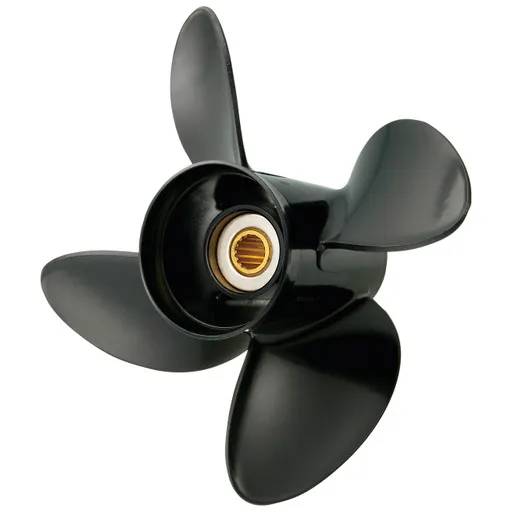
Solution: Upgraded to aluminum four-bladed, aggressive-pitch propeller.
Results: Doubled boat speed, improved hole-shot acceleration, smoother rides even under higher passenger loads.
🌱 Case Study 3: Commercial Ferries
Challenge: Reduce environmental impact and comply with regulations.
Solution: Replaced with environmentally friendly material propellers with optimized blade design.
Results: 12% reduction in fuel consumption, reduced underwater noise pollution, compliance with local environmental legislation.
These case studies underscore the various advantages thrust upon by today’s propeller upgrade, a span as wide as from enhanced performance to taking environmental account into their stride. Propeller choices tuned to the occasion and test results to keep constant have led vessel owners to clinch serious results, thereby revealing their wholebound potential.
Frequently Asked Questions (FAQ)
❓ What is an outboard boat propeller, and how does it affect my boat’s performance?
By definition, outboard boat propeller is a rotating device mounted onto the outboard engine, converting engine power into thrust. The blade design, diameter, pitch and material (aluminum or stainless steel) of the propeller directly influence acceleration, top speed, hole shot, handling, and fuel economy. Propeller selection should match the available engine power for the given boat application, in order to ensure the maximum possibility of the boat’s performance and efficiency.
❓ What should I really choose, aluminum or stainless steel outboard propellers?
Aluminum outboard props are mostly limited as they are cheap, lightweight, and the most common type for stock replacement, but the line of a stainless-steel propeller provides better performance because of thinner blades enabling lower inertia due to greater strength and accuracy for fuel efficiency and peak speed. On the cost-assuming side of things, the value of performance is always more valuable with a stainless steel outboard prop; but simplicity of replacement if its low-cost carries out and casual usability are always entrapping.
❓ What criteria determine correct size and pitch of propeller for my engine?
Propeller types rely on engine horsepower, gear ratio, boat weight, and on-water use (whether for towing, cruising, or racing). The diameter and pitch should properly reflect the engine’s optimal range of RPM to fully actuate power. Consult your outboard propeller guide or seek advice from an expert that could ensure successful selection. Your propeller choice is a major factor in determining your overall performance.
❓ How does blade count affect propeller performance?
Essentially, high- and ultra-high-performance boats benefit from fewer blades. A three-blade, hydraulically shaped prop opens out the bow lift at lower RPM and adds a boat’s top end speed, while offering great acceleration properties. Four- or five-blade props give powerful performance in keeping low-end speed and high RPM, and also good acceleration. The blade number influences speed, the motor’s thrust, and the steering of the motor unit.
❓ What’s the difference between 3-blade and 4-blade propellers?
Three-blade propellers are generally geared towards balanced acceleration and top speed. The four-blade prop increases “hole shot,” handling and the ability to carry additional load at the cost of some top-end speeds – most appropriate with heavy boat or towing. You’ve got an either-or situation between three and four blades: faster speed-quick acceleration or better handling, lower RPM when running under load.
📚 References
- 📄A Review on Marine Propeller Performance of High-Speed Boat Running on an Outboard Engine – This paper reviews the performance of marine propellers for high-speed boats powered by outboard engines.
- 📘Marine Propellers and Propulsion – A comprehensive book covering the design, performance, and technology of marine propellers.
- 📄Marine Propellers Design – A detailed academic document on the design and performance of marine propellers.
- 📊Modeling Performance Improvement of High-Speed Boats Running on an Outboard Engine – This research focuses on performance optimization for high-speed boats using outboard engines.
🚤 Ready to Optimize Your Boat’s Performance?
Choosing the right propeller is essential for maximizing your boat’s efficiency, speed, and handling. Whether you’re upgrading for better fuel economy, enhanced performance, or improved reliability, understanding the fundamentals of propeller selection will ensure you make an informed decision that perfectly matches your boating needs and budget.