One of the imperative yet frequently neglected factors in choosing for the same boating experience briskly is the outboard motor propeller. The correct propeller could vastly change the boat’s performance, fuel consumption, and its handling on water level. But we have so many choices that bloomed the immaculate choice could seem sweaty to even seasoned boaters. These reasons make it an ultimate guide that describes every single thing you must know about an outboard motor propeller so if you want to speed up, enhanced fuel economy, or smoother rides, this guide will provide the knowledge to make an informed choice. Now, guide your boat to full potential and enjoy the water like never before!
Understanding Outboard Motor Propellers

What is an Outboard Propeller?
One main component of the outboard motor system is the outboard propeller which converts engine power into thrust, moving the boat forward or backward. It is fitted to the motor’s propeller shaft and usually has blades that rotate against the water. The boat performance is greatly determined by the propeller design, including its number of blades, pitch, and diameter.
At the very basic level, the propeller generates thrust according to aerodynamic principles. As the blades rotate, a difference in pressure is created in the water: lower pressure behind the blades and greater pressure ahead of them. Such pressure difference essentially moves the boat in the desired direction. A higher degree of efficiency is thus reached when selecting the apt propeller for the motor for whatever the activity—such as cruising, towing, or fishing.
It is apparent that picking the right outboard propeller is an important task if one aims to obtain ultimate speed, fuel economy, or performance in general. The size of the boat, its weight, engine capacity, and the purpose for which it is being used all serve as main pointers as to what propeller is acceptable. With a good match of propeller to the motor and conditions, this propeller allows for smooth handling, better control, and less load on the engine, hence delivering gratification to the boater.
Types of Outboard Propellers
Depending on the particular requirements of boating, one may find many types of outboard propellers. The three most important types are aluminum, stainless steel, and composite propellers. Aluminum propellers are cheaper and lightweight, and are the most commonly used because they provide a nice balance of cost and performance. Thus they are ideal for all sporting uses and casual boating.
Stainless steel propellers, conversely, are more durable and resistant to damage, mainly when used for high speeds or in difficult operating conditions. These propellers provide more efficiency and performance for those who want more speed and power. They are costlier than aluminum ones but are worth every bit of extra money because they last much longer.
Composite propellers are cost- and low-maintenance options that resist corrosion and can stand in where durability is primary. Being lightweight and easier to change in comparison to their counterparts, composite propellers act as a good alternative for low-impact activities by casual or inexperienced boaters. The right type depends on one’s personal needs and the conditions in which the boat operates.
📊 Propeller Material Comparison
| Material Type | Cost | Durability | Best For |
|---|---|---|---|
| Aluminum | Budget-friendly | Moderate | Casual boating, sporting uses |
| Stainless Steel | Higher cost | High durability | High-speed, demanding conditions |
| Composite | Low to moderate | Corrosion-resistant | Low-impact activities, beginners |
Key Components of a Propeller
A propeller consists of several key components working together to generate thrust that propels the boat ahead. The most prominent ones are the blades, the hub, and the pitch.
Blades
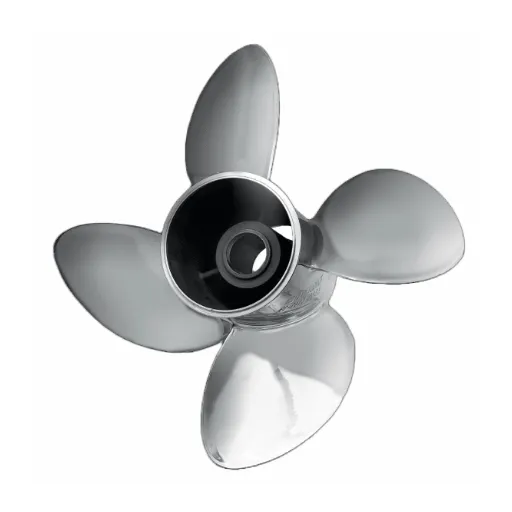
The blades are the visible angled parts of the propeller that cut through the water to produce thrust. The number of blades may differ, but a typical propeller has from three to five blades. The shape and angle of the blades govern how smoothly the propeller can move through the water and thus determine speed and performance.
Hub
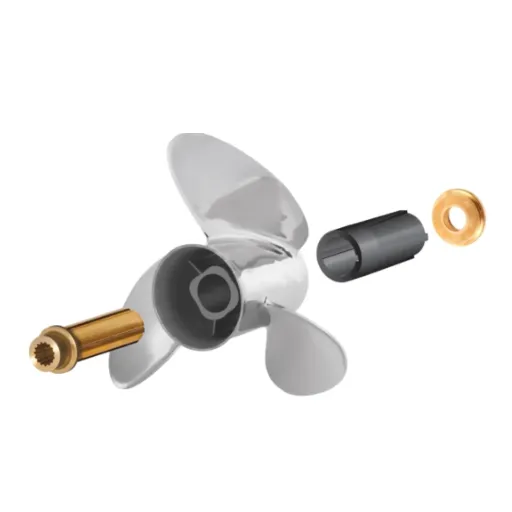
This part is located at the center of the propeller and attaches to the engine or driveshaft. The power is transferred to the blades from the engine so they can rotate. The design of the hub is also critical to ensure proper energy transfer and alignment.
Pitch
In contrast to more forward movement offered by a propeller of low pitch for higher speed, lower pitch enables more action and hence towing or tired steering.
💡 Key Insight: All five components are critical to the performance of any given propeller. Understanding the interactions between these components will help boaters pick the propeller that best meets their individual needs for speed, efficiency, or handling in different water conditions. The propeller must be maintained and selected for its fit to the given specifications to function properly and last longer.
Choosing the Right Propeller for Your Outboard Motor
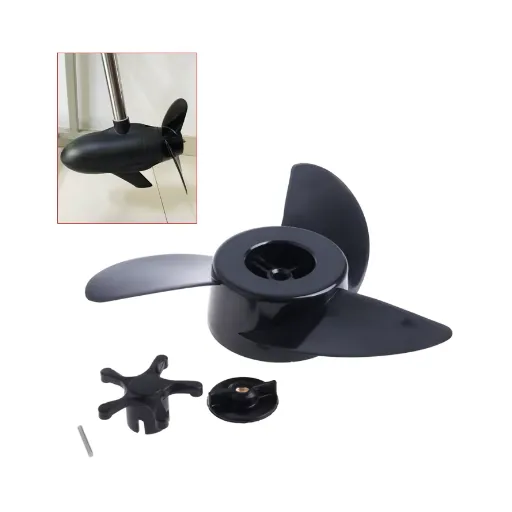
Factors to Consider When Selecting a Prop
Choosing the right propeller for your outboard motor requires understanding some important considerations for optimum performance. Those include:
🔍 Essential Selection Factors
1. Diameter and Pitch
Diameter is the measurement taken of the farthest extremes of the circular path formed by the tips of the prop blades. Pitch is the theoretical distance that the prop will move in one complete revolution. Higher pitch is preferred for speed, while low pitch is appropriate for heavy load or slow speed. These two parameters must be balanced for maximum performance.
2. Number of Blades
The number of blades affects the motor in performance and handling. Three-blades are typically the best for speed and performance, while four-blade configurations provide more stability and better handling for water sports or choppy water.
3. Material Composition
A propeller is generally manufactured using aluminum or stainless steel. Aluminum props are cheap and light and suitable for general purposes, whereas stainless steel propellers are the most expensive but offer better durability and performance, especially when put under heavy-duty conditions.
4. Usage Requirements
Consider the primary working purpose of your boat. For instance, water skiing or wakeboarding might necessitate a prop for special torque and quick acceleration, while a casual cruising craft would prefer one made for fuel efficiency.
5. Engine Compatibility
Make it an imposition to always check the specs of your outboard so that the prop matches the horsepower and shaft configuration of your engine. Incompatible prop usage drives fuel inefficiency and strains your motor.
6. Conditions and Environment
Water depth, salinity, and usual weather conditions also factor into deciding which propeller to use. As an example, waters that are shallow or loaded with debris are better suited with designs that are durable enough to take impact.
Choosing a propeller that will give the right balance between speed, efficiency, and reliability for your outboard motor must be based on evaluating these elements and knowing your particular performance goals. Allowing for regular interchange due to routine wear and tear or any seasonal changes in the environment will also be a key to keep things performing optimally.
How to Match Your Propeller with Your Outboard Engine
Understand Your Engine’s Specifications
Start by thoroughly reviewing the technical specifications of the outboard engine. Important metrics that need to be checked include engine horsepower, the recommended RPM range, and the kind of shaft it uses. These specifications can be located in the owner’s manual or accessed directly on the manufacturer’s website. An engine operating below maximum horsepower or beyond its recommended RPM range can cause damage to the engine and underperformance.
Select the Right Pitch
Pitch is defined as the theoretical distance that the propeller moves forward in one rotation and directly affects the RPM and speed of the boat. Recommended RPM range is determined when the engine is at wide-open throttle. A rule of thumb is that by increasing or decreasing a propeller’s pitch by one inch, an estimated change of 200 RPM occurs.
Thus, if the RPM is too high at wide-open throttle, a propeller with a higher pitch should be used; this reduces the RPM into a more appropriate range. Conversely, if the RPM is reading too low, a propeller with lower pitch provides increased acceleration and brings the RPM back into compliance.
Consider Diameter for Prop Size
Diameter can be defined as the full distance, measured from one blade tip to another on opposite sides of the propeller, forming a circular path. A propeller with a larger diameter produces more thrust, but it may reduce maximum achievable speed. Meanwhile, propellers with smaller diameters deliver less thrust and more speed. Typically, the manufacturer sets the diameter according to engine size; however, if someone is into specific activities such as towing, changes can be made to the diameter.
Take Into Account Blade Count
Blade count of the propeller can noticeably influence its behavior. A typical propeller has three or four blades. A three-blade propeller delivers more fuel economy and high top speed, an option that is well suited for use in cruising and racing. On the contrary, a four-blade propeller gives more power, better acceleration, and more stability, making it a favorite among water sports and for operation in rough water. Selecting a propeller suited to the type of activity you use your boat for guarantees the best performance.
Match Propeller Material to Your Application
The material used for a propeller affects durability, cost, and performance. Aluminum propellers are cheaper to purchase, easily repaired, and good performers for casual or light-duty operations. Stainless steel propellers are lighter, stronger, and much more efficient on high-powered engines and for rigorous use, though they are costlier. For example, if boating regularly in shallow or debris-filled waters, a composite or more durable aluminum may be more appropriate. Less damage will happen.
Factor in Boat Weight and Load
The weight of the boat and typical load it carries significantly affect propeller performance. Generally, heavier boats or boats that regularly carry heavy loads have a greater need for a propeller with lower pitch to ensure acceleration and thrust are adequate. Lighter, performance-oriented boats can therefore benefit from propellers with higher pitch for increased top speed.
Test and Fine-Tune Performance
Once the new propeller is mounted, run the boat at full throttle in typical conditions and check RPMs with a tachometer. The RPMs should be within the manufacturer’s recommended WOT range. If the RPMs do not fall into this range, adjust the propeller pitch accordingly, as discussed. Continued testing and adjustment results in the best performance, the best fuel economy, and a long engine life.
⚠️ Important Note: Matching a propeller with an outboard engine requires careful attention to the engine specifications, pitch, diameter, blade count, material, boat weight, and rigorous testing to assure optimum performance. Following these steps allows boaters to achieve smoother rides, improved fuel efficiency, and increased engine longevity.
Propeller Maintenance and Care
Cleaning and Inspection Best Practices
Proper maintenance of outboard propellers is fundamental to ensuring optimal performance and extending their lifespan. A well-maintained propeller operates efficiently, minimizes the risk of engine damage, and improves fuel consumption. Following are the best practices for cleaning and inspecting the propeller.
🛠️ Maintenance Checklist
- Regular Cleaning: Clean the propeller after every use to remove marine growth, grit, and debris. Use a soft brush and boat-safe detergent. Debris buildup can negatively impact efficiency and cause corrosion.
- Visual Inspection: Check the propeller for visible damage such as chips, cracks, or bent blades. Even minor damage can create vibrations and reduce efficiency.
- Check for Fishing Line: Fishing line tangled around the propeller shaft can damage seals and cause overheating. Eliminate entangled line with caution while wearing gloves.
- Inspect for Corrosion: Metal propellers, particularly aluminum ones, are susceptible to corrosion. Look for pitting, discoloration, or surface erosion. Early detection prevents more serious issues.
- Grease the Prop Shaft: Grease the propeller shaft using marine-approved grease to keep it from rusting and ease removal at a future repair.
- Balance and Alignment: An imbalanced or misaligned propeller will cause vibrations to run through the system, hence influencing potential damage to the engine and reduced efficiency. Any irregularity should be attended to without delay.
- Beware of Cavitation: Unusual bubbles on one side of the propeller or pitting could be signs of cavitation. Resolving the underlying cause, such as misalignment or incorrect blade pitch, will prevent further damage.
- Replace the Propeller When Needed: Should the propeller become heavily worn and beyond repair, it should be replaced immediately to avoid operational inefficiency or damage to the engine.
Executing these maintenance procedures will enhance the performance of your boat and cut down on potential repair costs. A well-maintained propeller means smooth voyages and keeps your boat in good condition for a longer period.
When to Seek Professional Help
Maintaining a boat’s propeller is necessary to keep performance at the top, but sometimes the help of a professional is required. I seek assistance when noting that the propeller has cracks, bending, or any deformation incapable of being corrected with a simple repair. Often, these issues need specific tools and knowledge to ensure that the propeller is either properly repaired or replaced.
I am also brought to rely on professional advice whenever my boat starts to vibrate or suffers in performance level despite regular maintenance. An inspection by a professional might reveal root causes such as engine misalignment or perhaps much more serious damage to the propeller shaft, which cannot be detected by ordinary onlookers.
The last thing I turn to experts for is upgrading or changing my propeller completely to fit the boat and satisfy its performance requirements. They bring their expertise in selecting the proper size, material, or design to maximize efficiency and fit with the engine. Time is wasted, damages could be inflicted further, and my smooth boating experience is jeopardized by not calling a professional whenever necessary.
Specialty Propellers for Unique Boat Types

Pontoon Propellers: What You Need to Know
Although much can be said about performing under pressure, every given situation, including pontoon propellers, calls for a design that best suits the performance of the boat. These boats normally have a somewhat flat and wide hull with might negatively impact water resistance. Hence, in most cases, pontoon propellers tend to have design issues to provide higher thrust at slower cruising speeds to ensure better handling and acceleration.
The pitch of a pontoon propeller refers to how far the propeller advances through the water in a single rotation; this greatly affects acceleration and top speed. The diameter is measurable from one blade tip to the opposite blade tip. The choice of material also comprises of aluminum and stainless steel. Aluminum propellers are the most common kind because they are cheap and can serve well under most situations, though stainless steel propellers go that one extra step of performance and life expectancy for the bona fide user.
Advanced blade geometry, including cupped edges and multiple blades, brings recent advances to consider, further optimizing performance in terms of drag reduction and lift increment. Considering such factors and talking to experts will allow the owners of a pontoon boat to make decided choices for upgrading the propellers, hence guaranteeing a smoother boating experience.
Performance Props for Racing and High-Performance Boats
Choose a prop that will give maximum speed, agility, and overall performance, an essential consideration for racing and high-performance boats. These boats require precision-engineered propellers that resist harsh conditions and deliver optimum thrust at the same time. Racing props, therefore, are made using sturdy materials such as stainless steel and high-grade alloy to resist wear and tear through high RPMs. Modern high-performance props are designed with the most advanced features, including custom pitch, rake adjustments, and CNC finishing processes, to suit particular needs of racing or sport performance.
The continuous changes closely related to newer and better hydrodynamics and material technology have their impact on high-performance props’ development. For example, cleaver or chopper-type propellers are designed to achieve its higher top-end speed with the lesser drag possible; therefore, these propellers become good for sprint races and exhilarating cruises. Also, manufacturers make use of computer simulations and real-world testing to tweak blade geometry and balance precision for specific boat and engine configurations, thus improving acceleration capacity, reducing cavitation, and being more durable under intense operational stresses.
An investment in the appropriate performance prop has the far-reaching connotations of everything from metal selection to design; everything should be analyzed on the type of boat hull and engine horsepower as there should also be some consideration regarding its intended use. Racing enthusiasts, concerned much about speed, may go for props of high pitch, while those worried about good cornering and low-end torque may choose the design that favors grip and lift. The pot could be made sweeter with some good sharing from experts, current testing results, and high-performance props that push performance to the limit and play the part in providing that edge in water sports.
🏁 Performance Propeller Features
| Feature | Benefit | Best Application |
|---|---|---|
| Cleaver/Chopper Design | Reduced drag, higher top speed | Sprint races, speed cruising |
| Custom Pitch Adjustment | Tailored performance optimization | Specific racing conditions |
| High-Grade Alloy Construction | Enhanced durability at high RPMs | Competitive racing, intense use |
| CNC Precision Finishing | Perfect balance, reduced cavitation | High-performance boating |
References
- MIT – Marine Propellers – A detailed document discussing the relationship between power, torque, and thrust in marine propellers.
- MIT OpenCourseWare – Propellers and Propulsion – A lecture resource covering the mechanics and effects of propeller systems in marine applications.
- NOAA – Understanding Propeller: Prop Diameter & Prop Pitch – A guide explaining propeller diameter, pitch, and their impact on boat performance.
- NOAA – Outboard Motor Lower Unit – A resource detailing the components of an outboard motor, including the propeller and its function.
- ResearchGate – A Review on Marine Propeller Performance – A study reviewing factors affecting marine propeller performance, including cavitation and efficiency improvements.
Frequently Asked Questions (FAQ)
Q: So, what exactly are outboard motor propellers?
A: Outboard motor propellers are the driving end of an outboard motor. The engine rotates the propeller shaft that generates the thrust to move the boat forward or backward. There are various types of propellers, mainly three and four-blade design. The propeller is vital in enhancing the performance and fuel economy of the boat while it is in motion on water.
Q: How do I go about choosing the correct propeller for my outboard motor?
A: When choosing an outboard motor propeller, factors like your boat horsepower, make of your outboard motor (Yamaha, Mercury, Evinrude, etc.), and the type of performance you need from the boat must all be taken into account. An outboard propeller guide will be able to help you determine which one suits your boat model and usages best.
Q: What advantages does a three-blade propeller have over a four-blade one?
A: Generally speaking, three-blade propellers are faster and have less drag, so they are best suited for applications where performance matters. Four-blade propellers, in turn, can accelerate well and are stable and are capable of handling heavier loads or operating in rough waters. It comes down to your boating requirements and the kind of outboard you have.
Q: What is the importance of the Flo-Torq II hub kit?
A: Certain outboard motor propellers require the Flo-Torq II hub, which has a built-in cushioning effect that protects the propeller and lower unit from damage in case of impact, hence improving the durability and longevity of the outboard propeller.
Q: Can an outboard propeller meant for one model be used in another one?
A: Some outboard propellers may be interchangeable, but make sure that it will fit your specific outboard motor model. Using any propeller not intended for your motor will most likely result in poor performance. Always refer to an outboard propeller guide so that you can learn expert advice regarding compatibility.
Q: How does a new propeller improve the performance of an outboard motor?
A: High-performance propellers, such as the Enertia Eco or Fury, will significantly improve the performance and fuel economy of an outboard motor. Selecting a pitch and diameter that best suit your boat will also improve acceleration, the boat’s maximum speed, and handling characteristics.