Propellers are the silent heroes of any boat’s performance, and selecting the right one can turn the scales on the water. The right propeller for Suzuki outboard motors is not only a matter of speed; it is also about optimizing fuel consumption, smooth operation, and meeting the particular requirements of your boat. This guide will provide you with all the information you need to determine the most appropriate Suzuki outboard prop for your boat whether you are an experienced sailor or a beginner. Keep watching as we explain all the necessary steps to increase your boat’s capacity and have an unmatched experience on the water.
Understanding Suzuki Outboard Propellers
What is a Propeller and How Does it Work?
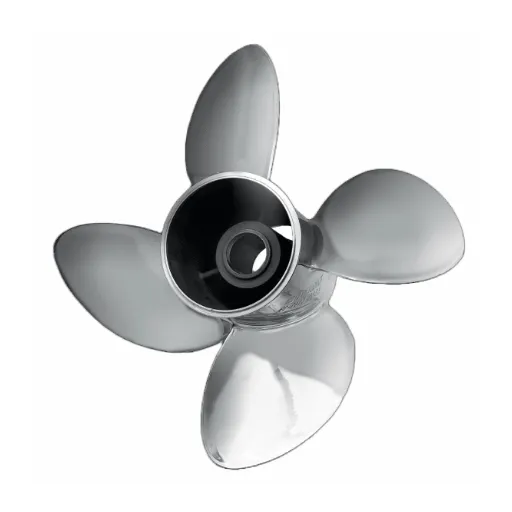
A propeller is a mechanical part with blades that turns in water and produces thrust, thus enabling a ship to either move forward or backwards. It makes the conversion of the engine’s power into the force necessary to push the ship along. It happens that the blades push the water thereby forming the high-pressure zone behind and low-pressure zone in front of the blades creating the pressure difference.
The design of the propeller, such as the number of blades, pitch, and diameter, are the major contributing factors to the propeller’s efficiency. The pitch of a propeller is the distance it would travel in one rotation if there was no slippage, while the diameter is the area covered by the blades in a circle. These parameters have an impact on the amount of speed and power delivered through the water. The proper selection of the combination results in a smooth operation and the best fuel economy.
Suzuki outboard propellers are engineered to unlock the maximum potential of the corresponding engines. The properly selected props can improve the speed of acceleration, maximum speed, and overall handling. Grasping the functioning of a propeller, along with its primary traits, empowers the boaters with the knowledge of making good choices thereby ensuring that their vessel operates efficiently and gives the best water experience.
Types of Suzuki Outboard Props
Suzuki outboard propellers are classified into different categories, each propeller type catering to the specific performance requirements and boat condition. The most widely used ones are aluminum props, stainless steel props, and composite props. Aluminum props are considered the best for daily use due to their low weight and low cost. The opposite is true for stainless steel props which are strong and last long, thus making them suitable for high-performance use or tough conditions.
Besides these, there is a group of Suzuki high-thrust and performance propellers that are engineered for greater acceleration and better handling. High-thrust variants infuse extra power during difficult pushing situations like towing or carrying heavy loads. Performance units are meant for speed-hungry boaters where they provide top speeds and accuracy in controlling the boat for water sports or fast cruising.
Important Note: The selection of the proper type of propeller relies on various factors like the dimensions and weight of the boat, the power of the engine, and the use of the vessel. Each of the different types of Suzuki propellers not only fulfills a specific need but also allows the users to achieve their ideal performance and maximum efficiency during boating. Always check with the Suzuki manufacturer’s guidelines or a certified dealer for propeller selection as they will ensure compatibility and safety would be the case.
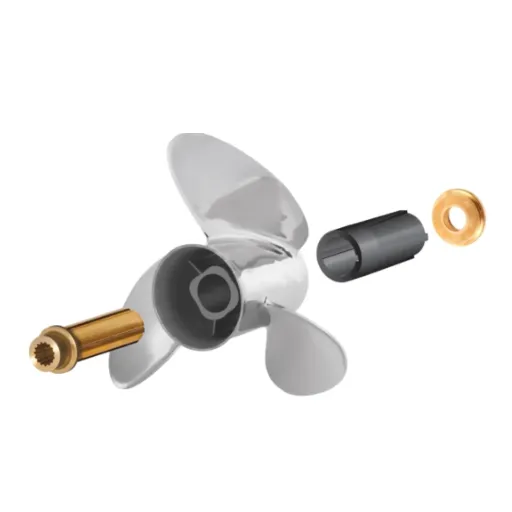
Key Components of an Outboard Propeller
An outboard propeller consists of several key parts, and each of them is quite essential to the proper functioning of the entire device:
Blades
Blades are the curved surfaces which are cutting through the water in order to produce thrust. They are available in various numbers, usually three or four, and each configuration possesses different performance characteristics. Normally, more blades ensure smoother functioning and quicker acceleration, whilst less blades might enhance the maximum speed.
Hub
Hub is the main part of the propeller which connects directly to the engine’s propeller shaft. It provides security to the propeller and at the same time, efficient power transmission from the engine.
Pitch
Pitch is a measure of distance that the propeller would have moved forward in one complete revolution if there was no slippage. It is responsible for the speed and power of the propulsion, with higher pitches leading to speed while lower pitches promote power and acceleration.
Diameter
Diameter is the circumference created by the rotating blades of the propeller. It is one of the most important factors affecting performance, with big diameters being fit for heavier trucks and small ones for the lighter and faster ones.
Rake
Rake is the inclination of the blades with respect to the hub. The higher rake angles increase the performance of the engine when it is at a high speed and also the ability to “bite” into the water for propulsion, while the lower rake is more suited to the stern-heavy boats.
Cup
The cup is the very slight curve that is added to the edge of the blades. It aids in the reduction of slipping and outright grip of the propeller is enhanced, more so during rough waters or when the vehicle is making sharp turns.
💡 Pro Tip: When it comes to selecting a propeller, knowing these component parts and their importance can help greatly in achieving the most efficient and effective operation of a boat. In addition, regular checking and upkeep of the above parts will also result in smooth and safe boating.
Factors to Consider in Propeller Selection
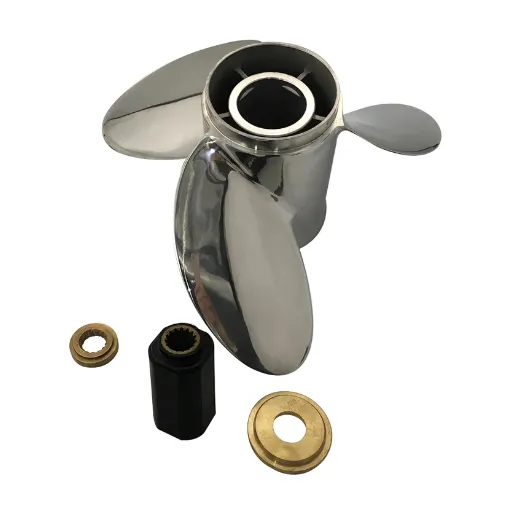
Engine Power and Propeller Size
The connection between the power of the engine and the size of the propeller is considered one of the most important factors to deal with when aiming at getting a vessel’s performance and efficiency at their peak levels. The engine power, which is commonly measured in horsepower (HP), is the factor that will directly affect the propeller’s pitch, diameter, and number of blades. A pitch that is either too high or too low for the power of the engine can result in a number of negative scenarios such as decreased speed, low fuel consumption efficiency, or even damaging to the engine as it “struggles” to keep up.
When it comes to engines with a lot of horsepower, it is usually the case that larger propellers with higher pitch are chosen in order to get the best thrust and the least slippage. On the opposite side, small engines generally will have the need for propellers with less pitch in order to get power that is just enough for smooth running and adequate operation. Besides the weight of the boat, the type of operation also plays a significant role in making these decisions; for example, whether to put it on the market as a cruiser or to be a towing boat.
📊 Real-World Examples:
- High-Power Setup: A ship that has a 200 HP powerplant and is going to be used for high-speed sailing over still waters may benefit from a propeller with a higher pitch (like 21 inches) for the purpose of getting the best efficiency out of the engine.
- Low-Power Setup: A low-power (for example, 90 HP) engine for occasional fishing might be working the best with a lower pitch around 15 inches.
The choice of a propeller that matches the engine power not only assures the highest RPM ranges but also the durability of the engine and better boating experience in general.
Boat Type and Usage
The right propeller choice is greatly dictated by the boat’s type and its usage. High-speed cruising boats, like speedboats or performance boats, have the advantage of faster-pitch propellers which allow for higher speeds but also are power-hungry to get the best performance out of them. On the other hand, workboats or fishing boats that focus on lifting capacity, managing in tight areas, or running stably at low speeds are more compatible with lower-pitch propellers. Such settings help the boat to work well in the middle to lower RPM range, assuring better control and saving fuel when going slowly for a long time.
One more decisive thing related with boating is the load—the weight and its distribution—as these affect the boat’s handling on water. Heavy-load-carrying boats like some cruisers and pontoon boats might need special propellers tuned for the added weight. It is common that a bigger-diameter or lower-pitch propeller is the one that creates the required thrust to move the ship in a water-efficient way. This is particularly essential for boats where the load conditions change often, as a wrong propeller choice can drastically decrease engine life by continually forcing the engine to work harder than the necessary.
The right propeller selection for particular boat types and usage situations is one of the main factors in fuel economy optimization. Long-term savings in cost should be an incentive for all boaters to think over the alignment of their boating with the propeller’s features. Wrong selection may lead to higher fuel use and more wear on the engine which is an expensive experience in the long-haul. Through recognizing these subtleties and taking advantage of new technology such as online propeller selection tools or discussing with marine specialists, boat owners will be able to guarantee that their boat operates in an efficient and reliable manner, thus easily adapting to and meeting their unique boating needs.
Material Choices for Suzuki Props
Choosing a propeller for your Suzuki outboard motor is not a simple matter if you are not aware that the material is the main factor that influences performance, durability, and costs. Suzuki props are commonly available in two main materials—aluminum and stainless steel—each catering to different boating scenarios.
⚙️ Aluminum Props
Aluminum propellers are chosen by many recreational boaters because they are inexpensive and versatile. These props are light in weight and are suitable for moderate boating activities, giving a solid performance for general use.
✓ Advantages: Low cost, lightweight, suitable for casual use
✗ Disadvantages: Risk of wearing out sooner, especially in harsh environments or with frequent exposure to rocks and debris
🔩 Stainless Steel Props
High durability and performance are the two characteristics for which stainless steel propellers are the first and foremost choice. Stainless steel is very hard, thus giving considerably better resistance to corrosion and to impact.
✓ Advantages: Superior durability, better acceleration, higher top speed, corrosion resistant
✗ Disadvantages: Higher price point, but justified for serious users and demanding conditions
When one is aware of the advantages and disadvantages of each material, he can easily make a choice that will not only satisfy his performance expectations but also be compatible with his sailing environment and be within his budget.
Performance Characteristics of Suzuki Outboard Props

Understanding Propeller Pitch
Propeller pitch denotes the theoretical distance a propeller would travel through water in one complete revolution, again, no slippage is assumed. To illustrate, with a pitch of 19 inches, the prop, in theory, would move forward 19 inches per rotation if there were no slippage at all. The pitch is one of the most pivotal factors that determine the overall performance of your Suzuki outboard motor, affecting the boat’s speed as well as its fuel consumption.
📉 Low Pitch Propeller
Allows the engine to speed up and pull loads much faster. Best for heavy-duty applications or water skiing activities.
📈 High Pitch Propeller
Enhances the engine’s performance in terms of speed at the top end. Ideal for cruising at high speeds.
⚠️ Warning: Mis-Matched Pitch
A mis-match can lead to a strained engine, thus decreasing its life and increasing its fuel consumption. One way to determine the right pitch for your application is to check the RPM at which Suzuki specifies for your motor model, and aim for that range of operation.
If one is well versed with the working concepts of propeller pitch and keeping an eye on the engine performance, he/she can thus take full advantage of the Suzuki outboard and experience a fun, smooth and efficient ride on the water.
Effects of Diameter on Performance
The propeller’s diameter is a significant factor in determining the performance and efficiency of a boat. This term describes the maximum diameter of the imaginary circle made by the rotation of the propeller blades. The right diameter selection is very important for the proper functioning and efficiency of the Suzuki outboard motor. Below are five main effects of the diameter on performance:
- Thrust Generation: Large diameters of propeller normally yield more thrust and are thus suitable for heavy boats, or when power is needed for the movement.
- Engine Load: The diameter of a propeller that is larger than necessary will increase the engine load, causing a reduction of RPM that may lead to the impossibility of having efficient fuel usage and strain on the engine.
- Acceleration and Speed: The smaller the diameter, the faster the acceleration and the higher the maximum speed, as a result of reduced drag; hence, it is a better option for light or fast boats.
- Fuel Efficiency: Using the wrong diameter propeller can lead to extra fuel consumption. The right propeller size will incorporate both diameter and pitch so that the cruising and maximum speed fuel consumption is balanced.
- Cavitation and Ventilation: Using the wrong diameter may lead to cavitation and ventilation scenarios; where the air or water pockets disrupt the functioning of the propeller and the overall efficiency of the propulsion is reduced.
Considering all these factors and referring to Suzuki’s recommended specifications will help users in selecting the most suitable propeller diameter for the kind of boating they prefer.
How Blade Shape Influences Speed and Fuel Efficiency
The design of a propeller’s blades plays a crucial part in the acceleration and fuel consumption of a ship. Blades created with a higher aspect ratio—longer and thinner—are ideal for speed since they lessening the water drag. These blades are the best choice for nimble boats or those engaged in fast-moving sports. On the other hand, blades with a lower aspect ratio—shorter and wider—provide more thrust, hence they are the best for heavy loads or cases where the power for propulsion is more important than the highest speed.
Rake angle and blade cup design have also a large impact on performance. A cup—a little bend at the edge of the blade—helps to keep grip in the water, particularly at high speeds, it then provides stability and lessens slippage. In contrast, a rake angle that tilts blades backwards is not only helpful in raising the bow out of the water but also provides efficiency at higher RPMs. This cuts down the hydrodynamic drag and can even translate to better fuel economy in certain conditions.
🔬 Innovation Spotlight
Among the new innovations in propeller technology, there are variable pitch blades and computational fluid dynamics (CFD) testing, which are allowing the manufacturers to improve the propeller shapes for the best possible performance. These new discoveries are making possible for the boaters to have the ideal balance between speed and fuel use, according to their requirements.
Finally, the knowledge of how the blade shape affects the ship’s performance gives the users the power to choose wisely according to their vessel’s architecture and purpose.
Maintaining Your Suzuki Outboard Propeller

Regular Maintenance Tips for Longevity
The maintenance of your Suzuki outboard propeller in the right manner is very important if you want it to last and to work at its best. This is a short list of the main tips that will help you with your propeller maintenance:
🔍
Examine for Damage Consistently
Very often check your propeller blades for nicks, chips, or breaks. Even slight damage would nevertheless be a factor and it would be a good idea to deal with the problem early on before it spreads so as to avoid performance loss and increased fuel consumption.
🧼
Wash the Propeller and Shaft
A thorough cleaning of the propeller and the shaft after every use, especially in saltwater, will help to get rid of all the dirt, barnacles, and salt that might have built up. One of the advantages of this process is that it prevents rusting and enhances the operation of your propeller.
🔧
Lubricate and Remove Debris
Every now and then, apply the marine-grade grease to the propeller shaft to protect it from rust and to make the propeller easy to detach when it needs to be. Good lubrication also helps to keep other parts inside from being worn out.
🔩
Secure the Propeller Nut
The propeller nut can become loose over time because of vibrations. Make sure it is tight based on the torque specifications provided by the manufacturer to prevent losing your propeller while you are out on the water.
🎣
Fishing Line and Debris Check
Look around the propeller hub for any fishing line that might be caught or debris. If these are not taken care of, they may eventually lead to the seal being damaged, resulting in expensive repairs.
❄️
Proper Storage During Off-Season
When the boat is not being used, take the propeller off, give it a good cleaning and keep it in a cool, dry place to avoid any damage from moisture or the environment. In addition, you could cover the engine and the area around the propeller as an extra measure of protection.
✅ Bottom Line: Keeping your Suzuki outboard propeller in perfect condition would mean not only prolonging its life but also increasing the performance and efficiency of your boat. These little actions can have a huge impact on great and worry-free water adventures.
Identifying and Repairing Common Issues
To detect and astutely fix common troubles with your Suzuki outboard propeller, being observant and proactive is the key. One of the most usual issues is the propeller being damaged; that is, dings, cracks, or bends are often caused by hitting submerged objects. All these problems lead to performance reduction, vibrations that are more than normal, or increase in the amount of fuel consumed. Regular inspections of the propeller for any visible signs of wear and tear are important because, through early detection, more expensive repairs can be avoided.
⚠️ Common Issues to Watch For:
- Physical Damage: Dings, cracks, or bends from hitting submerged objects
- Cavitation: Loss of thrust due to air bubbles, often from improper positioning or wrong size selection
- Debris Entanglement: Fishing lines or weeds causing shaft or seal damage
- Excessive Vibration: Often indicates blade damage or imbalance
Cavitation is another problem which is often overlooked, and it could lead to a loss of thrust due to the loss of air bubbles. This can be due to improper positioning of the propeller, wrong size selection, or damage to the blades. Ensuring that the propeller is properly fitted and replacing it if need be is the way to deal with this. Moreover, often getting entangled with waste material like fishing lines or weeds can lead to damage of the shaft or seals. Quick clearing of the waste material and installation of a propeller guard can considerably decrease the chances of this happening.
🛠️ Repair Best Practices:
When repair or replacement is required, always go for genuine Suzuki parts as these will give you the best compatibility and performance. And if the owner’s manual is not clear, professional help can be sought to make sure that the repairs are done correctly which would in turn reduce downtime and keep your boat running at a good pace. With the help of timely maintenance and attention to details, these common problems can not only be solved but also the life of your outboard motor can be made longer.
When to Replace Your Propeller
Usually, I discover that changing the propeller takes place indeed when its activity has already decreased or when there is some damage which can be seen. For instance, if I detect that my boat is having a hard time getting to its normal speed or there is a lot of noise due to the operating, it is usually a good indication that the propeller is probably bent, dented, or damaged in another way. My first action to determine whether replacement is necessary is to inspect the blades for signs of wear like chips, cracks, and distortion etc.
🔄 Signs It’s Time for Replacement:
- Difficulty reaching normal speed
- Excessive noise during operation
- Visible chips, cracks, or distortion on blades
- Decreased fuel efficiency
- Unusual vibrations
- Performance needs have changed (new boating activities)
Another cause of my considering to replace the propeller is that my old one has lost its applicability for the level of performance that I want from my vessel. In case I start using my boat for activities like towing watersport equipment or covering longer distances, I will evaluate whether changing to a propeller with a different pitch or material might be more suitable for me. This kind of upgrading can bring about the desirable results in terms of fuel efficiency, speed, and overall performance.
⚠️ Important: I think it’s also important to support me on this take that it is better to act sooner than later with respect to the propeller damage suspicion. Operating with a faulty propeller can put extra strain not only on the engine but also on the other components, thereby resulting in more expensive repairs. On the other hand, regularly taking care of propeller and waiting to replace it just when needed is the guarantee that my boat will be running smoothly, safely, and efficiently.
Comparing Suzuki Propellers to Other Brands
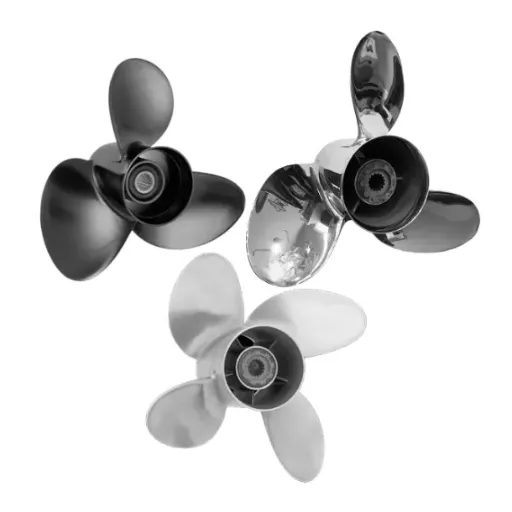
Why Choose Suzuki Over Competitors?
Pioneers in the field with their remarkable propeller designs, elaborate craftsmanship, and unflinching dedication to performance, Suzuki has no match in the propeller market. One of the marc advantages is the precision engineering that every propeller receives, which makes the compatibility with Suzuki engines optimal. This teamwork guarantees not only fuel efficiency but also very little vibration and longer life spans, all of which are vital for trustworthiness in the long run. Moreover, different kinds of stainless steel and aluminum are among the most advanced materials employed by Suzuki and they are corrosion-resistant as well as capable of enduring the most extreme marine conditions thereby ruling them out as good choices for only a few boating applications.
Innovation & Technology
Suzuki Precision Control system and Lean Burn technology for highly efficient and eco-friendly performance
Precision Engineering
Optimal compatibility with Suzuki engines ensures fuel efficiency, minimal vibration, and extended lifespan
Premium Materials
Advanced stainless steel and aluminum with superior corrosion resistance for extreme marine conditions
Customer Support
Extensive dealer network, warranty coverage, and dedicated after-sales service for peace of mind
Among the factors that lead to the selection of Suzuki rather than the competitors is the uninterrupted flow of money towards the research and development of the latest technologies. Suzuki employs such technologies as the Suzuki Precision Control system and Lean Burn technology which not only effectiy the engines but also the propellers as highly efficient and eco-friendly. Hence, these innovations allow the boaters to not only cut down on the fuel expenses but also to reduce their environmental footprint which is an important factor in the present-day world that is increasingly becoming eco-conscious. Other companies might be able to demonstrate some improvements, but very few can rival Suzuki in terms of commitment to merging performance with sustainability.
Above all, Suzuki’s constant dedication to customer delight and after-sales service guarantees an extra layer of security. The company makes available to users a large number of propeller types that are fitted to specific motor models and boating styles so that the users have not only the free choice of selection but also the confidence in their choice. On top of that, with a large dealer network and warranty coverage, the replacement and maintenance are no longer a hassle, which is a great source of reassurance. While others could use pricing as a strategy to compete, Suzuki keeps on offering marvelous harmony of value, quality, and innovation which paves the way for their lion’s share of the marine industry.
Performance Comparisons with Other Outboard Propellers
The performance comparison of Suzuki outboard propellers and their competitors reveals several major factors that support their superiority. The umbc propellers are carefully designed to gain the maximum thrust, fuel efficiency, and longevity no matter the marine conditions. While generic or aftermarket propellers tend to fall behind less in total thrust and fuel saving due to their good quality manufacturing, Suzuki’s designs often provide a smoother acceleration and more speed on the top end, and this is made possible by their state-of-the-art engineering and use of technological materials.
📊 Performance Highlights:
- Fuel Savings: Propeller tests conducted in similar vessels have shown that Suzuki models can very well cut down the fuel consumption by as much as 10% while still keeping or even surpassing with performance the output of other branded options.
- Low Cavitation: Regularly the patented Suzuki propellers show very low cavitation rates, meaning they will always give steady performance even in the most extreme conditions or when heavily loaded.
- Durability: Advanced anti-corrosion coating provides long-term effective resistance against saltwater and environmental wear.
For example, propeller tests conducted in similar vessels have shown that Suzuki models can very well cut down the fuel consumption by as much as 10% while still keeping or even surpassing with performance the output of other branded options. This can result in a huge amount of money saved in the long run for those who are long users of the water. On the other hand, regularly the patented Suzuki propellers show very low cavitation rates, meaning they will always give steady performance even in the most extreme conditions or when heavily loaded.
When it comes to the durability issue, Suzuki is mastering the use of modern technology in conjunction with the adoption of refined manufacturing methods, which are the main sources of innovative anti-corrosion coating, that provide long-term effective resistance against saltwater and environmental wear. Hence, for recreational boaters as well as for professionals who require reliability in hard conditions, their propellers act as a perfect choice. In summation, with regard to efficiency, quality, and innovation commitment in marine propulsion technology, Suzuki still excels over its competitors in the immediate future.
📚 References
- University of Wisconsin-Milwaukee – Suzuki Outboards Owners Manual: This manual provides detailed technical specifications for Suzuki outboards, including information about propellers.
- Yuin University – Suzuki DF140 Lower Units: This document offers an overview of the Suzuki DF140 outboard motor, discussing its power and compatibility with various propellers.
- Universal Technical Institute – Outboard Motor Anatomy: This article explains how outboard motors work, including the role of the propeller in propelling the boat.
Frequently Asked Questions (FAQ)
❓ What are Suzuki outboard props and why are they important?
The props or propeller of Suzuki outboard motors are the main parts of Suzuki boats that are very necessary to receiving performance and efficiency on the water. They transform the engine’s power into motion, thereby enabling the boat to move. The selection of the right propeller is very important in ensuring the engine is not overloaded and the engine’s performance is optimized.
❓ How do I choose the right Suzuki boat propellers?
Taking into account such things as your specific Suzuki engine, the weight of the boat, and the use for which you are going to the propeller, you are able to choose the right Suzuki boat propellers. In addition, our propeller guide can help you filter your choices according to these standards, thus, making sure that you are getting a prop that will give the best of the boating experience.
❓ What factors should I consider for my selected Suzuki engine?
If you are thinking of your selected Suzuki engine, consider its horsepower, the weight of your boat, and the water conditions you will be working in. Such factors will determine the size and pitch of the suitable Suzuki outboard props for your configuration.
❓ Can I use any propeller on my Suzuki outboard?
You may feel that it would be okay to use any propeller, but it is better to go for Suzuki outboard props that are especially made for your model engine. Wrong prop usage can lead to performance issue, engine damage and not so safe conditions while sailing.
❓ How do I ensure proper loading of my Suzuki boat?
You should load your Suzuki boat properly by spreading the weight evenly while staying within the limits set by the manufacturer. Correct loading will not only make your boat more stable but also let your Suzuki outboard props to work at their best.
❓ What maintenance do Suzuki outboard props require?
Maintaining Suzuki outboard props includes damage check-ups, cleaning to remove any debris, and lubrication of the propeller shaft. These regular checks will help keep performance and life expectancy up, thus enhancing the quality of the boating experience.
❓ How can I maximize the performance of my Suzuki outboard?
The performance of your Suzuki outboard can be maximized by having the right propeller size and pitch, regular engine maintenance, and following correct loading practices. You can also take advantage of our propeller guide, which will help you select the most suitable prop for your individual needs.
🚤 Ready to Optimize Your Boating Experience?
Selecting the right Suzuki outboard propeller is crucial for maximizing your boat’s performance, fuel efficiency, and overall enjoyment on the water. By understanding the key factors outlined in this guide—from engine power and boat type to material choices and maintenance practices—you’ll be well-equipped to make an informed decision that enhances your boating adventures for years to come.