Seemingly easy or difficult to understand, whichever may be the case; as doing it in any case would prove to be quite interesting and exploring. One of the most important aspects that anyone has to uncover is what is port and starboard side. These words are not found in a dictionary only because they are related to water temporarily; on the contrary, such words embrace entire understanding and knowledge. In that case why, why does the subject require division? What’s beneficial about having a society of mariners, or these funny terms of linguists – the words ‘sterns’ and ‘ports’? In this very discussion, we will explain what these words mean, when they appeared each, and lastly show how to use them. You who have just sailed on a boat once, wonder-er of the sea, this essay is to increase your awareness on aspects of sea navigation, and this will be done through the following.
Definitions of Port and Starboard
What is Port Side?
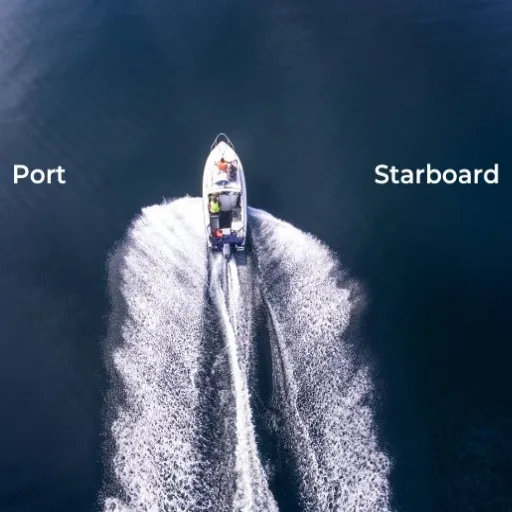
Port in a layman’s language means the left side of a ship if standing on the deck facing the front of the vessel. International language of seamen incorporated this terminology so as to avoid any confusion among crew members while navigating or docking or performing any other operations onboard. Using the word ‘port’ is easier for the sailors, otherwise terms like ‘left’ bring a lot of confusion since it is dependent on the orientation.
The early shipping vessels always docked with the deadweight turned to the portside harborage so that the rudder which was located on the right side of the ship was not hindered. The term ‘port’ remained and got universally accepted as regards this side of a vessel.
Understanding the difference between port and starboard enables one to communicate effectively and work efficiently at sea. This is necessary especially on occasions when other vessels are being overtaken or when signals have to be made, or in case of emergencies. No matter how much experience one may have, this term should be known by everyone who is aboard a vessel to enhance teamwork and safety.
What is Starboard Side?
If you are on a ship and facing towards the bow, that is the front end of the ship, the right side is known as the starboard side. This is done so as to cut any form of misunderstanding that may arise during the course of sea adventures or while giving directions. The term ‘starboard’ has been manufactured from the Old English dialect ‘steorbord’ (meaning the side that turns the ship) because in times past, ships were steered using steering oars which were positioned on the starboard side.
The starboard side has also been conventionally fitted with green lights that shine at night for that purpose. These lights are meant to give direction so as to prevent accidents on the water. Together with port, starboard is an important concept in the language of seafaring as it is constantly used to effectively communicate direction and position between seamen.
It is crucial for every person associated with a seafaring vessel, either through employment or travel, to understand what is port and starboard side. This is to ensure proper coordination amongst the crew members and contribute to the safe navigation of ships. On a normal run as well as emergency, this knowledge and the ability to recognize the starboard side help in keeping order and preventing any chaos that may ensue at any point in time.
Differences Between Port and Starboard
Emphasising direction, the port and starboard sides of a vessel are on the left-hand stage and right-hand stage respectively when looking forward from the head of a deck onto the sea bow In other words these introduce the use of preferred descriptions of its parts irrespective of where any person happens to be at any moment in time.
The word ‘starboard’ has its roots in the old English word ‘steorbord,’ which indicates the ship’s steering oar side before the invention of the central rudder devices. On the other hand though the word ‘larboard’ was in use but due to its similarity in pronunciation with ‘starboard’, the word ‘larboard’ was replaced by the word ‘port’. It was specifically called “port” for the reason that it is the side which was placed on port when a vehicle was anywhere at rest including harbors.
Port and starboard are terms of direction that can be used by the ship’s crew at any given point on board to indicate an undertaking. The terms are unambiguous and are required as part of safety during operations of a ship or craft, such as port maneuvers or emergency operations. Such understanding helps in ensuring that one consumes port to the left side, with the old joke that “port is the only drink that every shipmate should have” still winning with some people. One thing that is common everywhere is the expression to make it simple in recollection what is port and starboard side where port does actually have four letters, as understood by the notion “port is left”.
Historical Origins of the Terms

Development of Port and Starboard
What is port and starboard side and where these words come from? If you are wondering about these questions, let me tell you about early naval traditions. In those days, there were no today’s vessels, there were wooden canoes operated by paddles and later on boats with steering oars. A steering oar was attached to the right side of the boat because steering was mostly done using the right hand. And indeed, “starboard,” the term used for the right-hand side of the ship today comes from the Old English word “steorbord” meaning steer board or steering board. The left side of the ship, which was tied close to the dock, was called larboard in the beginning. This is because both the words “larboard” and “starboard” sounded similar. Keeping this factor in mind, ‘port replaced the word ‘larboard in the 1800s. ‘Port’ is indicative of the side of a ship when it is positioned toward a port or dock.
Without these terms, people will definitely get confused when giving or taking orders on board of ships. Navigation requires specific instructions, as people’s lives depend on it, when sailing in bad weather or in case of military operations. It was the Royal Navy, who in 1844, have begun referring the left as ‘port’. In turn, the Royal Navy positively impacted many other navies around the world and must have contributed to this phenomenon. Nowadays, what is port and starboard side is a set of words and terms indispensable in the work of the people at sea.
Moreover, the significance of ‘port’ and ‘starboard’ is sustained in the modern world by the advances in technology that relate to navigation and communication. The use of these terms will not die anytime soon as they are useful in the coordination of operational procedures, even today when ships are fitted with all the latest radars and GPS. These come in handy as we look no further than the past of the shipping industry and the vast ocean experiences of earlier generations and yet have significant relevance even in the present day. In addition, the usage of port and starboard is undoubted while using classical ship building or ultramodern ships, proving how seriously the industry takes conservatism.
Cultural Significance in Maritime History
Maritime affairs have enjoyed a long and turbulent tradition as well as interesting innovations and exchanges of culture. In times past, the sea was not just a trade channel, but also a promoter of social progress and cultural interaction. Language, symbols, and customs of navigation are aspects that have a long history of development, representing a very touching human spirit of striving to conquer nature through exploration.
The sea or the sea borne mats a great level tradition– often pictorial already. Just think in a simple form of impressed form as a second half of the history which is, you create not and desert after seeing a survival picture of a sailing after ‘The Odyssey’, but recommence to offer the blow images of the marquetry decorated ships at sail (clipper). These, stories and objects are where the intrinsic characteristics and nature of maritime practices are remembered and lived by maritime societies and understood as what is port and starboard side.
In today’s context, the study of maritime history continues to influence the current norms, particularly with regard to the construction of ships as well as global standards of maritime laws. Even with the rapid development of communication technology, some of the old ways of communicating such as the use of flags and semaphore still find application in certain circumstances which is an evidence of the timelessness of such traditions. In addition, historical ship preservation as well as the existence of maritime museums and coastal festivals ensure that the sea culture is still alive today. This indicates the blend of maritime history with advancements and stresses the fact that concepts of the history of seas have meanings even today.
Evolution of Nautical Terminology
The historical roots of terminology specifically developed for the sea are very long, being closely linked to cultural and technical characteristics of navigation that has been practiced throughout centuries. The seafaring nations namely Phoenicians, Greeks, and Latins invented their own vocabulary for ships, instruments, the sea itself and traveling in it as well. Words such as prow, stern, keel are inventions from the ancient times and are some of the first words one learns when taking up marine lexicon. The words were also adapted in the many parts of the world where the sea is a huge part of life so much so that it became a maritime oriented lingua franca with minor distinctions.
The expansion of the naval forces during the Age of Exploration witnessed the unprecedented development in the scope of the nautical terms. Larger and technologically sophisticated ships alongside improved navigation system demanded the introduction of numerous new terms to serve in their respective functions and parts. It is in this spirit that words – “brig”, “galleon” and “caravel” – came to particularly be used to indicate particular ships. Likewise, words for the instruments used in the navigation, like he “astrolabe” and “sextant” were coined, owing to the advances within the field of seafaring. Because this was the case, mercantilism and colonialism equally enhanced the exchange and the absorption of other peoples’ words and phrases, making sure that every single word in a language was akin to a nautical term.
As contemporaneous aspects advanced, so did the use of steam-powered ships, radio communication, and even the global positioning system, changes that greatly affected the language of the sea. The original terms, though still relevant in context, had to be expanded in order to encompass newer types of vessels such as those with ‘boiler rooms’, ‘radar’, and ‘autopilot’. Nowadays, computers and orbit navigation has come with ‘AIS’ and ‘ECDIS’, words that modern-day sailors cannot do without. Despite these technological changes, many old sayings still exist, especially those related to the sea, encompassing a lot more than just the descriptions of long-time practices. This transformation of the sea language clearly illustrates the adaptable and persistent character of the seafaring legacy.
Memorable Tips for Differentiating Port and Starboard
Clever Mnemonics to Remember Port and Starboard
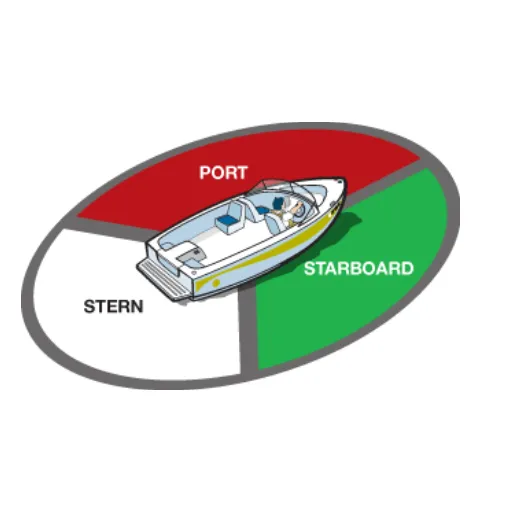
Getting to know how to tell what is port and starboard side can prove itself to be a challenge to those who have just gotten into nautical activities. A simple way to remember how to differentiate between the two is that the words port and starboard also begin with the letter L and in terms of direction, port is the left side. On the other hand, the word starboard, is a transmutation of the old English ‘steorbord’ meaning ‘steerboard’, which is the right side. Another cue that will reinforce the image absorbs the lighting rule of navigation: red light at the port and green at the starboard.
Another technique that is worth considering is an image in which the word “port” is seen in connection with that of ‘red wine’, as both relate to the same color. This link is quite helpful especially when it comes to the lights during navigation; the port is dipalysred on the left side and uses red color during the night. Further, the light on the starboard, which is greeeen, can be remembered by simply, saying there are trees on the right side. All these little images or words are wonderful, especially for such quick decision making moments.
Additionally, it is also necessary to incorporate these memorization techniques with actual practice or ship handling experience learned on the vessel. Nowadays, thanks to modern technological advancements, even digital maritime simulations provide visual designs that distinguish port from starboard, fostering skills development in this area. Therefore, with all these amusing ways, accompanied by real practicability, anyone will be able to tell what is port and starboard side without any trouble, hence more accurate and protective navigation.
Visual Aids and Tricks to Remember the Difference
The use of visuals aids allows an easy and efficient way to ensure that the difference between what is port and starboard side is well understood. One of the many tricks employed by training purpose is matching the number of characters found in that particular term with components. For example, “port” includes four letters just as the word ‘left’ does, therefore, the port of any aircraft is turned to the left of its nose. In a similar manner, a “starboard” means the right side of the plane.
Another visual approach is to refer to the colors of the navigation lights used in the vessels. A red light is used to mark the port and a green light is used to mark the starboard. Such colors are frequently employed in diagrams and training materials for marines.
Furthermore, figures showing a ship from the top-view may also be very supportive in explaining the idea. Combine these with effective applications such as in progress tools or scale models to facilitate retention. The technology makes use of modern gadgets and electronic chart display and information system (ECDIS) that at times in picture format, indicates the sides of a vessel to ensure useful reference and perfect recall in case of application in real life.
Using Color Associations for Navigation
Color perception tricks are one of the handfuls of realities that have been utilized in navigation to ensure the safety of sailors and navigators. And here are various ways in which these colors help. The rules concerning what is port and starboard side in a ship, and today, its sides are marked with the green and red lights respectively. This is further used in instances where they pass near vessels at night or during poor weather where boat traffic is present as here these vessels does not in contact or collide with each other. These lights present on the vessels are governed by the international maritime rules and therefore are recognizable and unified in cover all the waters of the world oceans and seas. The use of colors is thus a visual aid for the mariner as most of the aids to navigation, such as buoys, are designed in specific colors depicting passage, danger, or direction.
Incorporating functionality of color associations through technology extended their meaning. Consequently, even in digital maps equipped with navigation, users will notice how different regions will have a certain color to indicate warning as part of the system, helping a seaman to understand where the danger or where the certain area is. Several systems also found application in displaying visions of the surroundings through color coding distinguished above most prominently by use of augmented reality, the current and the future of the regard in systems. These features come in handy while exploring landmarks visually providing necessary information without over crowding the display with excessive information in unfamiliar navigation.
similarly, care needs to be taken to design an inclusive training method that enables the utilization of the color scheme in navigation by anyone. Compliance with such efficacy processes encourages the design and use of other optic-aid approaches such as texturing, symbol substitution and enhanced contrast among others for the safety and access of the clientele by navigation practitioners. There is an underlying potential in the old-style color cues, with newer technologies and approaches that allow structures to be universally used without ever missing their practicality and accuracy in any type of seafaring work – leisure or business.
Practical Significance in Modern Navigation
Importance of Port and Starboard in Safety Protocols
The words “port” and “starboard” are key in navigational practices as they provide stability in the informational space and they do not change their position unlike all other geographical objects. Thus, when asking any crew member or a captain and especially during rushed activities these designations – port for the left of the ship and starboard for the right – will always be such as when the latter two do not require any explanation to the one who requires directions. This, in turn, removes any possibility of switching perspectives to “left” and “right” directions that varies according to their own orientation, enhancing security and operations optimisation stresses elimination.
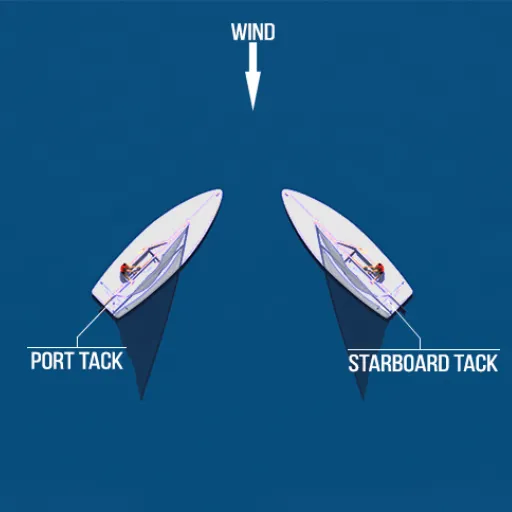
Procedures put in place for precautionary measures are also almost synonymous with these directional phrasal verbs, especially on waters where boats and ships may be maneuvered. Other means of avoiding accidents, like the COLREGS, illustrate vividly the relevance of port and starboard. Such statutes clearly define actions that vessels are meant to undertake in order to give way, or keep going, depending on where they are positioned with respect to each other. For instance, in a crossing overtaking situation, a ship which is going to cross another from its port side is obliged to go around behind, whereas the other one has a duty to maintain the course. Without such inbuilt use of the port and starboard, there would be the risk of misunderstanding the strategies thereby causing errors in the liberty of two vessels. Sensitivity to the port and starboard decreases vagueness and allows the vessels to navigate safely without collisions or mishaps.
Thanks to the strides in navigation technology like the availability of GPS, radar, and even automated alerts, the concept of the use of port and starboard sides has become even more pronounced. Through constant monitoring with the aid of real-time data, captains can keep track of the positions and movements of other vessels, which in turn makes it possible for them to act in conformity with all rules and guidelines. When combined with this kind of system, the continued use of port and starboard language still remains imperative as far as the maintenance of maritime safety in view of growing global trade and congested waters. In the end, the more the necessity of these words endures, the more it reflects the degree of relevance of archaic notions in the face of the use of modern means of navigation.
Role in Communication at Sea
Depending on the angle of approach, this is why there are the terms “port” and “starboard” and not just left and right. The root cause of the relative directions like left and right bubbles out from the fact that these terms may be different for a given person or object. Therefore, adopting those terms keeps the challenge that may result to a minimum. Hereunder five entries which quite vividly illustrate this point.
- Simple Seafaring: Simple command like `port ten degrees’ or ‘hold it on the starboard ‘help the crew to follow orders due to the fact that nothingback this cement.
- Lucrative Engagement With Crew Members: By allowing common words to be used by each of the crewmembers everyone is able to understand one another, and such enhances coordination and workability in the ship.
- Prevention of Hits: But isn’t it the case that people can be warned well in advance of which direction will be used for any maneuver, isn’t it? You won’t get ships crashing into each other or into the ground because it was raining heavily or you were surrounded by so much shipping traffi as to make navigations terribly difficult.
- Responding to a Crisis – Effective Planning: Another bared meaning – determining which emergency means or workers will be moved where and how fast.
- Observed Legal Constraints: The rules of communication are therefore respected or rather the mere pronouncement of these terms ensures conformity to such policies as the Convention on International Maritime Order avoiding collisions at sea.
Therefore such rules, ensure and emphasize the need to ensure coordination and safety in the global maritime industry where such communication practices are used.
Port and Starboard Lights: Understanding Their Function
Port and starboard lights, also referred to as navigation lights, are some of the most essential pieces of equipment for safety on the water. These aids to navigation help mark the presence, position and orientation of other vessels in low visibility conditions or at night. Normally the port side of the vessel lit up in red light and the starboard in green light. This is to avoid confusion and accidents on sea by the introduction of a cardinal color scheme that is used in all maritime industry across the globe.
To keep a steady standard and easy understanding, it has been made mandatory in most nations that colours lights are regulated in such a way. In this context, by the provisions of the International Regulations for Preventing Collision at Sea there are standards concerning navigation lights that line up with their respective type, size and usage of the vessels. For instance, a sailer less than 20 meters can carry a mast-head which is a combined lantern showing both red and green light(s), but those vessels that are bigger should have the same lights separated and placed in their individual compartments. Such lights are designed to assist sailors in understanding what is port and starboard side of a vessel and thereby take corrective steps as required.
There have been improvements in design and durability of port and starboard lights with the advent of modern technology. For example, LED navigation lights produce brighter light and last longer while using less Current in comparison to incandescent light bulbs. Some vessels have integrated these lights in automatic systems that check them for functionality to reduce the chances of any lapses or non-compliance. While the traditional principles have been embraced, technology has been improved significantly, this however in turn does not omit navigation lighting which is still very essential in the safety of operations of the businesses in the global world.
Real-World Applications of Port and Starboard

Usage in Maritime Industries
The notions of port and starboard are essential constituents of marine culture and are very important for navigational purposes, considering the waters across the globe. Such direction-related terms are not only used worldwide, but they also ensure efficient communication, especially in congested zones or even high-risk implementations. Terms that define left (port) and right (starboard) when leading the directions of ships, or even boats of any type or size, also help prevent any such simple accidents in which crewmates and other ships may involve each other. There are such sentences explaining what is port and starboard side for the ship.
Other than navigation, port and starboard are also operationally important in many marine industries including shipping, fishing and oil exploration. For instance, cargo handling needs to be planned using properly identified port and starboard specific orders for loading as well as unloading in the case of container ships especially. Also, it is essential to properly balance the weight on both sides to avoid tipping over or any other accident of a vessel. In the same way, fishing boats designate port and starboard sides as a means to control use of nets on the two sides of the boat.
Additional efforts in improving upon the directional nature of port and starboard have been purposefully incorporated by modern navigation systems. Recent systems include, for example, radar, global positioning systems and automatic berthing while making use of these directional systems to enable manipulation of vessels in restricted ports or in deep sea conditions. A good example is dynamic positioning systems, where offshore oil installations keep a vessel operational at a certain point by controlling its position from port and starboard. Coupling age-old seafaring traditions and modern developments, the maritime sector does not forget about safety measures and working efficiency.
Recreational Boating: Navigating with Port and Starboard
In the context of marine recreation, it is essential that the meaning of ‘port’ and ‘starboard’ be known. These long-standing and essential terms are used to describe the ‘left’ and ‘right’ of a water craft when viewed from the bow facing in. It helps a unit to avoid any unwanted and safe actions when the purpose needs to be fulfilled. For instance, such actions involve asking permission to enter a port, overtaking a different craft, or cutting corners where possible without jeopardizing safety. Knowing port and starboard has become highly imperative to mariners as it ensures safe passage through the lanes and brightless nights. For this reason, boaters follow the customs of using red (indicating a port) and green (meaning a starboard) navigation lights, whenever they are on the water at night.
Recent technological developments in tandem with conventional maritime activities have transformed leisure boating as we know it. Digital navigation is now enhanced by integrated GPS and electronic chart displays that depict the position in more details. Others include augmented reality systems that allow navigation information to appear visually in front of the operator in a way that is stereoscopic; thus, port and starboard could come in handy. It’s especially valuable for people who aren’t seasoned sailors or simply have come for fun only and are not planning to delve into the study of nautical science or rules of seamanship while in the water.
It has been statistically proven that majority of accidents in recreational boating are mostly due to operator inexperience and poor understanding of the rules of navigation. That includes questions like what is port and starboard side. Thus, it is written with purpose for materials on boating classes which now more often than not includes 3D navigation lessons of course and many of the dynamic simulations as well. Wearing protective vest coupled with knowledge in wearing protective vest & proper boating procedures is an all-around activity for relaxing on a boat. It is encouraging that maritime professionals back their prescriptions with innovative means to enhance safety and enjoyment.
Application in Aviation for Directional Accuracy
One of the most crucial components of every flight is maintaining directional accuracy for a safe and smooth flying experience. It is for this reason that in contemporary aviation there are numerous technologies and systems which have been introduced to improve accuracy when navigating, especially in difficult circumstances such as take-off, landing, and on course control. The following list provides an overview of some of these applications and devices, which help in directional accuracy in aviation:
- Global Positioning Systems (GPS): This is a technology that provides guidance with precise coordinates with the aid of satellites hence it allows pilots to plot accurate courses even in adverse conditions.
- Instrument Landing System (ILS): It has a navigational aid to assist pilots in landing an aircraft along an accurate glide path, in low visibility conditions.
- Attitude and Heading Reference System or AHRS: AHRS provides inputs on an aircraft’s attitude in all three axes of rotation, which are pitch, roll and yaw, underlining the importance of stability to a pilot.
- what is port and starboard side: Due to the nature of aircraft operations, the technical function of a flight management system (FMS), which enables navigation and all the planning of an aircraft’s route, has sophisticated systems installed that do that integrates multiple functionalities and guides the airplane through the airspace.
- Weather Radars: These have been integrated in the aircraft, and their purpose is to give information on the weather in real time for the purposes of rerouting or changing the direction of the aircraft to avoid turbulence/storm.
The control of a vessel’s movement and communication between the navigation officers on the port and starboard sides of the bridge is as essential as communication between air traffic control and the pilots of airplanes. Pilots know how to steer an aircraft and, more importantly, they know what is port and starboard side and how to treat the left and right wings.
References
-
Louisiana Universities Marine Consortium (LUMCON) – Nautical Terms Activity
A PDF document that explains nautical terms, including port and starboard, in the context of ocean research. -
Oregon State Marine Board – Nautical Term Glossary
A glossary of nautical terms, providing clear definitions for port and starboard. - Click here to read more.
Frequently Asked Questions (FAQ)
Q: Define port side and starboard side of a ship?
A: This particular query is perhaps the simplest yet instructive one for a beginner mariner. Thus, to say what is port and starboard side means the same thing as left and right side of a boat respectively, rather… Port side means the side of the vessel on the left to the person approaching the front (bow) end. On the other hand, the starboard side is on the right when one is looking forward. The above-mentioned locations refer to the ship. Therefore; port and starboard are fixed and determined elements as opposed to left and right which change with regard to the direction in which a person is facing at the moment.
Q: What is the reason behind the sailors using these words rather than saying left or right?
A: It may seem sometimes that sailors overcomplicate things by inventing additional terms. But in fact, using these systems provides an enhanced level of safety and communication. When you give a command, “Look out to the left!” the crew member might look left of their shoulder which can be behind the ship if they happen to be facing towards the stern. This would not be the case when the terms port and starboard are used. At any position and direction of the crew member, “starboard” will always be one side of the ship. This exactness averts incidents in difficult or demanding situations.
Q: From what region or country is the word starboard originally?
A: The etymology of the word is rather interesting and goes back to the earliest English. Originally, ships did not have a closely centered rudder, instead there was a single oar at the stern for steering. As most people were naturally right-handed, the oar was fixed to the right side of the vessel. There was ‘stéor’ in accordance with the old English word for steering, while side was ‘bord’. This made a word stéorbord that turned into ‘starboard’.
Q: How was the term “larboard” substituted with the word “port”?
A: Most often than not the timber steering oar was located on the right side of the ship, hence on the measure of the ship that the ship would be berthed to avoid damaging the steering oar. This side of loading came to be known as the “larboard” (“laddebord” is the old English for the loading side) But, when bellowed against strong winds and vexing waves, “larboard” position sounds too much like “starboard”. The British Royal Navy therefore, in the mid-19th century, decided to substitute the word “larboard” with “port”, indicating the side of a vessel which faces the port or dock when berthing.
Q: What colors are used to show the port or starboard sides of a vessel?
A: While at sea, colored navigation lights are used by ships at night to indicate the direction of such ships to other ships. The red color light is always used to represent the port side while the depicted green color is for the starboard. They are standard globally. At night, if you gaze on a red light on the water, there is a port side of another ship facing you. For the avoidance of any doubt, the other ship in all probability has to give way.
Q: What can I do to help me distinguish the sides correctly?
A: There sure are several simple tricks that have stayed with many. The most famous one is the one which counts the letters. The word “Port” consists of four letters, and so does “Left”. Consequently, Port is Left. To avoid confusion with colors, just remember that Port wine is red in color, so it means Port is Left and Red. As soon as you make that conclusion, you instantly realize that Starboard is Right and Green.
Q: Do you also use ‘what is port and starboard side’ for planes too?
A: Yes. There was much adoption of sea-going practices in aviation. As far as the passengers seating is concerned in a conventional aircraft, the rows of seats that are to the left of the aisle as one is facing towards the nose of the aircraft are their port entrances while the ones on the opposite direction are starboards. These borrowings are extended to spacecrafts/ stations like the ISS where up and down is not possible to assign distinct directions.
Q: On a cruise ship which side is more preferable?
A: Every vacationer has fought around this. The views of the port cities on that side of the ship’s body should be better since the term port meant one of the sides that e.g. a ship lays against a quay. That may seem incorrect since, in the new vessels, a ship gets near one of the sides depending on the design of the port and waves. Both of the sides are neither favorable nor unfavorable for ocean gazing as a default but in the cases where the cruise is paying a visit to a particular coastline i.e. Alaska, starboard is preferred to see the civilization and not the water.
Q: If a ship travels backwards, do port and starboard change over?
A: No, this doesn’t happen. This explains what is port and starboard side created for to stay constant and eliminate. Even while the boat is moving backwards or you are still standing on the back deck watching the vessel’s track in the water, the port side is still the port side. This is always on the left of the frame as to the front of the ship. With that, the emergency protocol becomes relevant in any ship movement.
Q: Regarding rules of navigation during collision, what ought to be observed by a pair of vessels?
A: If two power-driven vessels are approaching each other at an angle (crossing), the vessel that has the other vessel on its starboard side shall be the vessel that otherwise violates conduct. Picture it as traffic lights, starboard light is green, some of the participants might call it go ahead, and clashing. On your starboard side, the vessel is at the “green zone” and has the right of way in case you look at it, in case of you are looking at any vessel on your port side where the red light is on, you have the likely priority of right of way, however navigationally you should always keep this in mind.