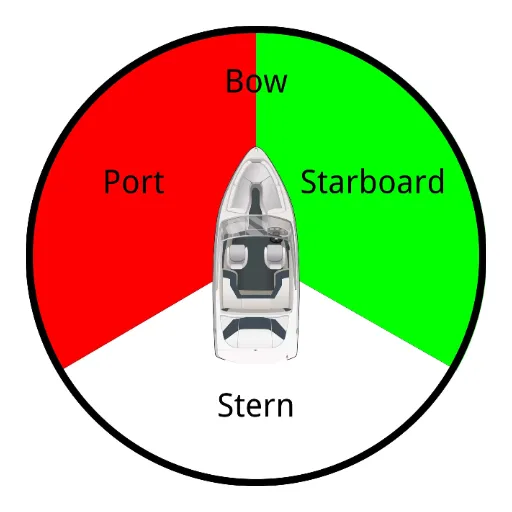
Both sailing and general marine activities have their own language, custom, and protocols. Thus, knowing the right words to say in particular cases is one of the key skills necessary for one’s involvement in any kind of aquatic activities. In this regard, it is quite important to understand the fundamental difference between the port and the starboard. It is not simply a matter of maritime terminology but of the system which makes maritime operations organized and effective. Irrespective of where you lie on the sailing scale; as an expert, a specialist in watercraft, or just an eager learner, this paper helps in explaining what the starboard side of a boat is and its relevance to steering clarity, all facing the same direction mostly on the open waters.
Introduction to Starboard Side
Definition of Starboard
When you stand on a ship facing its bow or its front, you will be looking at its right section, that is what is the starboard side of a boat. The term origins and standard practices of the sea faring shipping companies forces every member of a crew and all the ships to follow specific directions on these.
The evolution of the word “starboard” can be explained by the history of ships. It can be traced back to “Steorbord” which was two Old English words which meant the steering side. This is because the paddle, rudder or any other kind of devise which aided the steering of early ships was attached on to the right implying that this was the most important section of the ships.
Learning the concept of starboard is very important for efficient and responsible maritime operations. For instance, a vessel needs to give way on the starboard side in order to avert a collision with another vessel. Such knowledge aids crew members as well as passengers keep orders and protocols in situations even in very busy or very muddy and even very rough waters.
Importance of Understanding Port and Starboard
It is very important to know what is the starboard side of a boat for several reasons. Safety, communication and operational efficiency may be enhanced on a boat because of knowing port and starboard. The terms on a boat are designed to eliminate directional confusion on board a ship, which means that instructions, as well as orders, are less likely to be misinterpreted.
Key Benefits:
- Safety Enhancement: Maritime laws often favor the starboard side to prevent collisions, especially in busy waterways with limited visibility
- Clear Communication: Eliminates confusion in directional instructions regardless of where crew members are positioned
- Operational Efficiency: Facilitates precise coordination during docking, anchoring, and emergency responses
Historical and Linguistic Origins
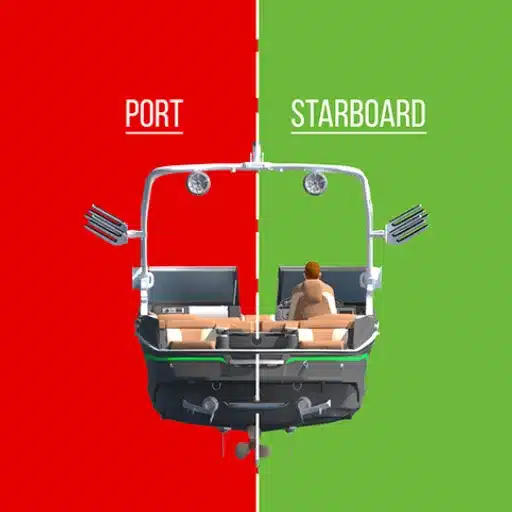
History of Nautical Terminology
The origin of the language used in navigation is cross-cultural. Most superpowers of the civilisation that relied on the sea for their maintenance and expansion—trade, maritime exploration and naval power—developed particular terms as delineating the parts of a ship, navigation, or carrying out any activity within the sea. These terms have also gone through various changes as the technology of the designs of ships and the extent of the travel carried out in the sea has changed.
If we talk about the origin of some terms one can find them used in the first boats afloat because of the design of the earliest boats ever built which could be steered only on one side. Maritime languages also bore the marks of interaction, contributing to a large extent to the dictionary of English during the time of the discoveries, with influence from Spanish and Dutch.
It became important to develop a standardized nautical terminology with the globalization of maritime activities. Language barriers in shipping were overcome by organizations such as the International Maritime Organization (IMO) to enhance maritime communication worldwide. This history shows how important shared language has been to enable cooperation, safety and efficiency at sea.
Etymology of Starboard and Port
The designations of “starboard” and “port” originated from very early sea-going culture. The origin of the word “starboard” is derived from Old English words for “steor” – “to steer”, and “bord” – “side of a vessel”. Once, most of the boats were managed by a rudder or steering oars mounted on the right side – the steor-bord or starboard side. The configuration proved to be functional since many of the crew members were right-handed, which in turn facilitated the use of the steering oar.
During the same period, the word “port,” which referred to the left side of a ship, came to replace yet another word: “larboard.” The word “larboard” has its provenance in Middle English and it is believed that the term ‘lar’ has some relationship with the loading and carrying of cargo. But the word “larboard” was dispensed because it also sounded like “starboard” when one tried to shout above the normal level of noise, and that happened sometime in the nineteenth century. The word “Port” is actually caused by the position of the ship at the structure called port in such a manner that the steering oar on the starboard side is clear.
The very old times of “port” and “starboard” remind us of the continuous development of nautical language as highly practical and correlating to the needs of expanded international voyage.
Evolution of Boat Navigation Terms
Changes in boating terminology can be attributed to time and technology. Sun and stars served as a means of determining the direction when an early sailor was moving; crude tools such as kamal and astrolabe were also applied during ancient times. As time passed, novel designs such as magnetic compasses and sextants were developed, vastly improving the methodology regarding accuracy and consistency.
As travel in immense waters was now a norm for many seafarers, there was a need for sailors to use very specific language for assessing ship motion, direction or action. Phrases such as bow, stern, starboard and port became essential references, eliminating the many gaps which could occur in communication.
To this day, development of the nautical dictionary continues, hand in hand with advancement of technologies used for navigation. Global Positioning Systems, electronic charts and even autopilot systems have ensured the expansion of terminology while the description of positioning still bears reference to time tested methods. Although supported by modern advancements in navigation, the maritime world philosophy does not allow the old ocean dictionary to die.
Practical Tips for Distinguishing Starboard from Port
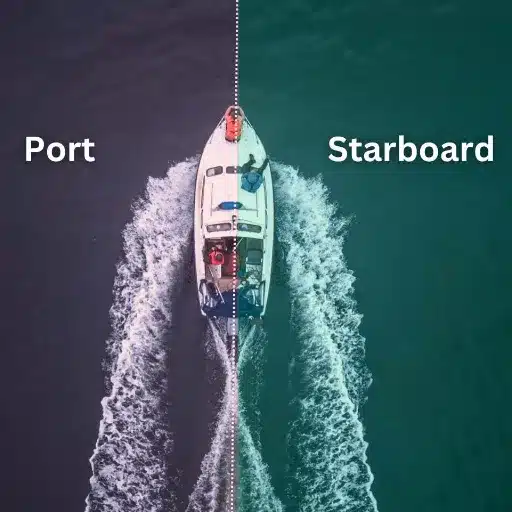
Memory Aids for Remembering Port and Starboard
For one to navigate well, one must be able to tell the left from the right when one thinks in terms of ships. For those who may find this confusing, here are some proven ways to make sure they do not get the two mixed up:
Word Association
The word ‘port’ contains 4 letters, whereas ‘left’ is also a 4-letter word hence port goes to the left side of the ship.
Color Coding
Starboard is represented by the color green while port is represented by red. These colors on their respective parts help recall which is which quickly.
Port Wine Reminder
Associate the red color of port wine with ‘port’ which makes the left side a red one.
Hand Gesture Method
Putting your hands in front of you, your left hand creates the ‘L’ shape referring to ‘left’, meaning port side.
Visual Cues: Colors of Port and Starboard Lights
Lighting protocols for port and starboard have been adopted in order to enhance water safety especially at night or when visibility is impaired. The port side of the boat is the left half that is facing the front of the boat and is indicated by a red light. On the other hand; when it is the boat’s starboard side, green light is shown which is right half of the boat. These particular color practices enable skippers to determine what is the starboard side of a boat and hence other traffic in the vicinity very quickly and distinctly which is crucial for any collision avoidance or adherence to the rules of the road.
International Regulations for Preventing Collisions at Sea (COLREGs)
Such lighting installations follow the International Regulations for Preventing Collisions at Sea (COLREGs). It is a universally adopted set of rules governing all activities at sea. These are not just assignations of colors, but they also fit all criteria for placement. In the case of port and starboard lights, for instance, they are attached in a manner that they can be seen 90° or more on both sides of the forward beam.
The advancement of technology has led to upgrading most navigation lights on ships to Light Emitting Diode (LED) types capable of providing better visibility, enhanced lifespan and reduced power consumption. These compounds the security of usage of the conventional methods in marine transport in a non-obtrusive fashion.
Mnemonic Tricks to Remember the Difference
Several mnemonic devices and links exist to help guide an individual when it comes to understanding what is the starboard side of a boat and as a result, these definitions are often simplified:
- Four-Letter Rule: Both “port” and “left” have four letters, making port the left side of the vessel
- Red Wine Association: Port is linked to its red navigating light where understanding red wine as port wine makes it easy to remember the respective colors
- Green = Right: For starboard, it’s easier to remember green is the light for the right side therefore associate green with starboard
- Historical Connection: Remember that starboard was the steering side, and the word starboard itself comes from Old Norse ‘stjórnarborði’ which means ‘steering side’
- Stars and Direction: Imagine the stars that gave direction in the deep sea, you can associate the starboard side with stars to the right side
Nautical Navigation Rules
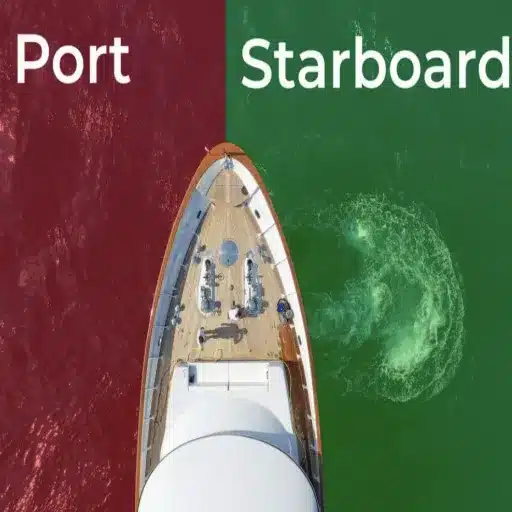
Understanding Port and Starboard in Navigation
It is essential to grasp the concepts of port and starboard when it comes to maritime navigation for one to be safe and practical. This is because when one is facing forward in a boat or ship, the port would be on the left side of the boat whereas the starboard would be on the right side of the boat. All these terminologies have been harmonized globally to avoid any misapprehension in transmission, especially between two vessels or in crowded channels.
Nowadays terms port and starboard have their presence not only due to convention, but the important role played by technology and modern navigational systems. Ships, for instance, have navigation lights outfitted on them; the green light stands for the starboard side, while the red light stands for the port side. Therefore, during the time when the day turns into night or when visibility is poor, these lights are very useful in terms of assisting other ships in positioning and determining direction.
“Rules of the Road,” or COLREGs, made up of these terminologies, are a set of measures that have been put in place to manage the movement of ships. They specify the ship’s duties in accordance with the port or starboard of the ship. A case in point is the vessel from the starboard side which is allowed to cross while your vessel is required to yield.
Right-of-Way Rules: Starboard vs. Port
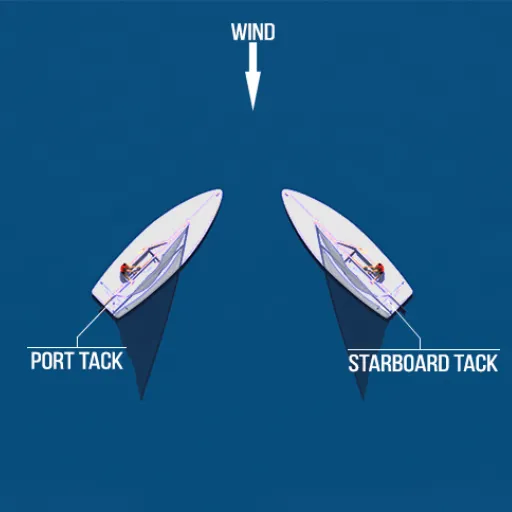
Right-of-way rules state that a vessel on a port tack must give way to a vessel on a starboard tack to avoid collisions.
| Key Point | Starboard | Port |
|---|---|---|
| Tack Rule | Has right-of-way | Must give way |
| Wind Side | Wind from right | Wind from left |
| Collision | Priority | Yield |
| Responsibility | Maintain course | Alter course |
| Application | Universal | Universal |
Real-life Applications on Ships and Boats
Right of Way regulations are intended to make sure safety and smooth transit in water especially in areas with heavy traffic of water vessels serving different functions and different sizes. In regards to this, whenever vessels are sailing in a heavy traffic area, such as a shipping channel or harbor, it is necessary for vessels on port tack to be aware that they must give way to vessels on starboard tack. Such approaches ensure efficient management of operations and minimize incidents of collision.
All these elements, adapted to principles existing in modern navigational aids, help a person in command to receive such data in real time. For a sea crossing, the majority of boats are fitted with their own ARPA Radar (i.e. alerting systems) that will detect such traffic and report the courses and speeds of nearby targets, which direction they are tacking. Already having the information of who has right of way and welding this technology together, all watersmen can make more appropriate decisions in less time even in either the dark or restricted areas.
The principles equally apply to international sporting events such as yacht racing in which fair play is assured by following the rules of sailing designating who has the right to proceed over another, without delay. The sailors have to consider what is the starboard side of a boat or the port side of the boat while anticipating the execution of any maneuvers the opponents might make for safety as well as for avoiding being penalized for violating any of the rules.
Frequently Asked Questions (FAQ)
Q: Is there any way to know which one is starboard and which one is port without doing research?
A: There is such a method, it is called the trick of “port as in wine also has red navigation lights to the left while starboard is to the right.” It is better to say port and starboard than left and right on a ship because in that environment it is not left and right—it is port and starboard.
Q: How come sailors utilize port and starboard instead of left/right?
A: When a person talks about a naval setting then they say port or starboard because left and right alter with a person facing a particular side of the vessel; port and starboard are two different dimensions to the vessel that remains constant so that the ships can use the same directional system in every communication.
Q: With reference to the bow, how do you know which is starboard?
A: If the boat’s bow is what you are looking at directly, the right of you is called the starboard while the left is called the port. Hence, the right side is known as the starboard and the left side is called the port during any forward motion.
Q: What about the tricks or mnemonic devices? Do they offer any assistance in remembering which is port and starboard?
A: There are several ways of doing this: for example, “red port left, starboard right,” or perhaps “port is on the left” and “starboard is on the right.” These memory aids help simplify which side of the vessel is which.
Q: Does starboard mean something else such as port in the context of tacking?
A: The starboard tack and the port tack signify the side from which the wind is coming. A port tack has the wind blowing from its port side and a starboard tack has the wind blowing from the starboard side. It is the understanding of port and starboard which allows one to know who has the rights when sailing.
Q: How are port and starboard lights and markers used to identify sides at night?
A: Ships show green light on starboard while red light on port, so that the other boats will be able to know which side is which when it gets dark; port and starboard light colors are easy to recall sides and know which side those from the other boat can see.
Q: Can you use steering oar or helm position to identify starboard?
A: Traditionally most boats had the steering oar on the right-hand side which explains how the word starboard came to mean the right; even up to this day, we hear people give orders using starboard instead of using left or right as a helmsman in the boat will have a helm positioned there.
Q: How do port and starboard fit into general nautical terms and parts of a boat?
A: The words port and starboard form parts of the parts of a boat and form part of the nautical expressions. To enable more clarity and standardization most modern boats make use of words like ‘forward’ and ‘aft’ instead of ‘front’ and ‘back’ and ‘port’ and ‘starboard’ instead of ‘left’ and ‘right’ when referring to these parts of the boat.