When attempting to maximize efficiencies in the performance and effectiveness of a Yamaha outboard motor, one of the most important considerations is the prop. The right propeller has the power to boost speeds, fuel consumption, and overall control to any boating adventure. There is one thing about the boat propellers, which are not really different. And those are given choices, and choosing the best prop for your own Yamaha motor can seem quite confusing.
This guide was put together to serve the purpose of simplifying the process and providing all the information needed to back an educated decision. This article is designed for anyone who has lived and breathed the cruising world, or even a new water baby, in the understanding of an ideal Yamaha outboard prop and what to look for in choosing one to fit his/her needs. Let’s proceed and unleash your boat at its full potential!
Understanding Yamaha Outboard Propellers
What is an Outboard Propeller?
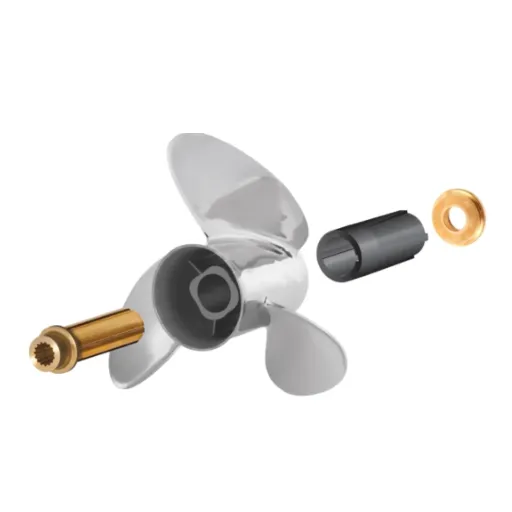
The propeller is a crucial element in a boat’s engine system, which converts the engine’s power into thrust, moving the boat. The propeller does this by rotating and pushing water backward for the boat to move forward. An ineffective outboard propeller may inhibit an engine from putting power into the boat to best use with the boat’s motion through the water.
Outboard propellers appear in various sizes, shapes, and materials, all affecting the boat’s speed, handling, and fuel efficiency. Diameter and pitch are the two key measurements that affect how the boat moves and need to be balanced. Diameter looks at how big the propeller is, while pitch measures how far the propeller moves the boat for one revolution. Picking the right diameter and pitch to fit the engine and the boat load is crucial in ensuring the boat’s proper performance under different conditions.
Types of Yamaha Propellers
The company Yamaha provides propellers falling into many categories intended for different boating needs depending on the construction material, performance goals, or specific applications. Propeller materials include aluminum, stainless steel, and high-performance aluminum.
Aluminum Propeller
Aluminum propellers, as a rule, are lightweight, inexpensively priced, and good to utilize under virtually all boating conditions. It is recommended for casual range and future work that match with lesser engines in providing serviceability and strength in mild conditions. Contrast this with lesser expense, which compromises, due to rapid wear and tear in rough environments compared to stainless steel.
Stainless Steel Propeller
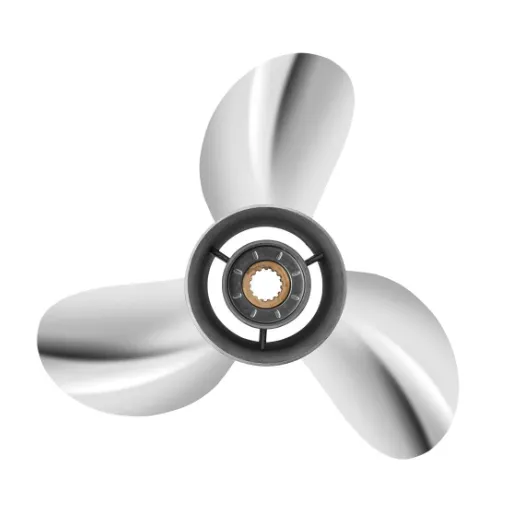
Stainless steel propellers are preferable due to their superior strength and efficiency. Their lack of flexibility makes them preferential over painted aluminum propellers because highly engineered blade designs can perform to the maximum. These propellers are suitable for a countless type of applications—such as high-end powerboats, which can run very fast where speeds are needed and high power engines having either prolonged life expectancy due to constant performance as per their demand.
Propellers for High Performance
Yamaha also offers a high-performance category of propellers for special applications like speed, acceleration, or particular applications like watersports. This could be in design catering to bass boats, offshore fishing, or skiing. All designs are mainly focused on best performance for customization.
Understanding the attributes of the different styles of propellers is what helps wise boaters choose the best Yamaha propeller suitable for their engine, boat usage, personal preferences.
Key Specifications of Yamaha Outboard Propellers
When you choose a Yamaha outboard propeller, it’s essential to understand the vital technical facets that will determine its overall performance and efficiency. Here are the most important peripherals that require serious attention:
Material
The two main materials available for Yamaha outboard propellers are aluminum and stainless steel. Aluminium propellers are lighter, cheaper and better for casual boating pleasure; the stainless steel propellers though will last a great deal longer, perform better at higher speeds, and are more suitable for heavy-duty users.
Pitch and Diameter
Performance-related characteristics of a propeller are decided by its pitch, measured in inches, which determines the boat’s forward thrust per prop rotation, and its diameter in inches, which is the diameter of the circular path traced by the blades. Yamaha has variants with different pitches and diameters but the many choices of this make are meant to allow them to be compatible with a great number of boat types for diversely capable or demanding engines and loads.
Number of Blades
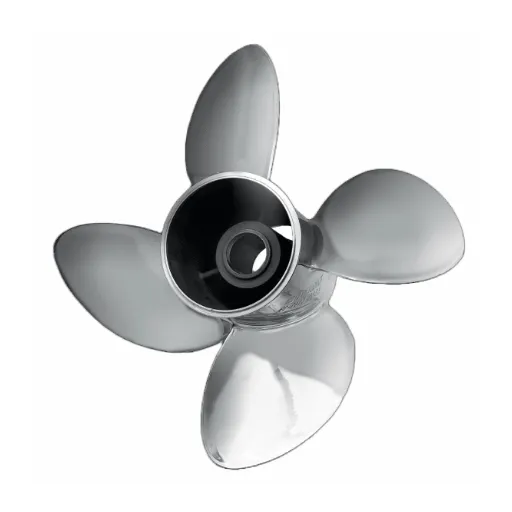
Yamaha propellers generally range from three blades up. The three-blade propeller, having an equal distribution of speed, is right at home in a variety of boating situations. Other types, such as the four-blade propellers, significantly improve thrust, stability, and overall control at low speeds, making them ideal for watersports, heavier loads, and perhaps rougher water.
Boat owners should always give special attention to these guidelines, so that the Yamaha propeller they choose not only matches their engine but also enhances their boat’s overall performance for their preferred activities.
Performance Factors of Yamaha Propellers
Thrust and Speed: How Prop Design Affects Performance
A propeller’s design surely has an essential impact on the thrust and speed of a boat; hence, due consideration should be given to optimal performance. The propeller’s geometry, diameter, pitch, and blade number are key for efficient and effective increase in power production.
- Higher-pitched propeller: Normally adds more speed since this pitch moves the boat further per revolution; however, it might lose low-speed ability required for quick acceleration, such as pulling heavy loads.
- Lower-pitched propeller: Provides high thrust at lower speeds, which is the best range for towing, traveling heavily loaded or in choppy waters.
- Three-blade propeller: The choice for the average, general user. At tailoring the balance between speed and efficiency for a variety of actions.
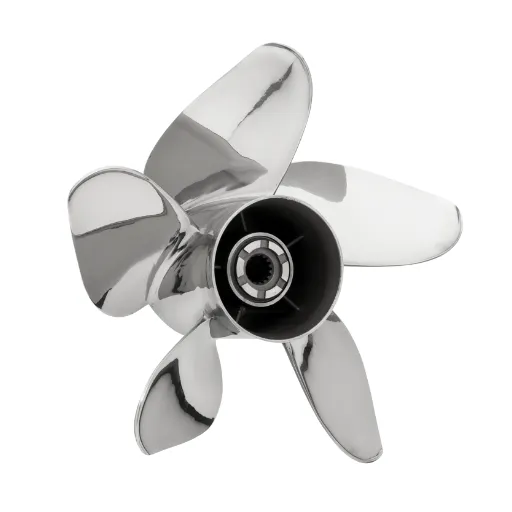
- Four or five blades: Guarantee a more balanced performance, more thrust, and better handling in the case of required stability. Think of watersports and rough weather.
The choice of material keeps varying by manufacturer; there are arguments for both aluminum and stainless-steel propellers. For example, stainless-steel-built propellers are better built for hard work, are less likely to deflect at high running speeds, and are more precise in handling. At a weight proportion/redistribution vs. cost perspective, aluminum propellers provide more of an option.
💡 Advanced Features: In propeller design, further advancement came with new features such as cupped blades and variable-pitch designs, amplifying the degree of control and efficiency thereof. Cupped blades decrease ventilation in stormy water conditions to maintain a continuous thrust; and propellers with a variation of pitch provide adaptivity of the variable speed condition for optimal performance.
The Role of Pitch in Prop Performance
The propeller’s pitch is the most critical contributing factor to boat performance, which dictates its speed, efficiency, and general handling. Pitch generally refers to the distance covered by the propeller in a single rotation if there was no slippage. Thus, choosing the right pitch for your propeller is essential when attempting to meet your boat’s demand for performance by influencing engine RPM (revolutions per minute) and fuel efficiency.
Effect on Engine RPM
A reduced pitch propeller boosts engine RPM, which allows escalating acceleration and peak performance to be carried out at lower speeds. Conversely, a higher pitch propeller reduces engine RPM acceleration, promoting higher top ends.
Speed-Thrust Dichotomy
Lower pitch propellers generating more thrust are ideal for activities, such as wakeboarding, skiing. On the contrary, relatively higher pitch propellers might serve the purpose of high speed in open waters.
Fuel Efficiency
Proper pitch selection can help in lowering the vehicle’s strain, and therefore use fuel more efficiently. Unfit prop pitches, on the other hand, may be responsible for much greater fuel inefficiency and further damage to the engine.
Load and Weight Consideration
For boats carrying heavy loads or transporting gear, a propeller with a lower pitch is more appropriate as power and force will need to be increased to support that extra weight.
Performance in Different Conditions
The right pitch varies with water conditions. A lower pitch propeller works best in rough, choppy waters where control and thrust are needed, while a higher pitch propeller can be applied in calm waters for high speed.
Understanding these factors and choosing the right pitch propeller for your boat based on its use ensures the best in Performance, long durability, and guaranteed boating pleasures.
Materials Used in Yamaha Outboard Propellers: Aluminum vs. Stainless Steel
Stainless steel and aluminum are the two most common materials used in the manufacturing of Yamaha outboard propellers. Depending on the present boating requirements, each material has its own specific advantages to offer.
Aluminum is light, cheap, and perfect for all those recreational boaters on a freshwater setting. Such propellers are good for delivering durability under low-to-moderate horsepower engine use. With rights to boast of aluminum as an option fitting all possible uses, their easy serviceability adds weight to the same. This makes such propellers a good choice for novices and pleasure boaters alike.
However, stainless steel props are very popular for their durable building material, resistance to corrosion, and excellent performance level. These props really push under high-stress conditions, like in a high horsepower engine or saltwater, because of being so well built. Stainless steel propellers seldom flex under load, which means they have better acceleration, fuel efficiency, and top-end speed compared to aluminum propellers.
⚠️ Important Note: The choice between these materials depends so much upon budgeting, usage preferences, and the environment. While aluminum could be termed an affordable option for light-duty purposes, stainless steel makes disposal propellers an ideal choice for performance-boats that venture under challenging conditions.
Selecting the Right Yamaha Outboard Propeller
Matching Propeller to Boat Type and Engine Power
Most small ship environments work well for fishing purposes and so on; they may give you some suitable propellers for slower speeds and better fuel consumption properties, while the big boats that frequently go for pulling and sporting practices derive good benefits from high-thrust propellers that hold a good deal of force even under loaded situations. This is an issue that requires that a propeller for each boat be selected for certain power size as well as some particular requirements of the boat with reference to preferred performance and longevity.
Engine power has a very significant say in the matching of pitch and diameter of propellers. A propeller’s pitch has a direct bearing on its speed and on the ability of the engine to get close to its recommended range of RPM operation.
- Lower pitch: Gives better acceleration and more power, making it ideal for heavier boats or those requiring good torque.
- Larger pitch: Hones maximum speed and is ideal for lighter boats or watersports enthusiasts who want faster performance.
Choosing a propeller that permits your engine to function within its optimal RPM range optimizes conditions of efficiency, fuel economy, and minimal strain on the engine.
Moreover, significant design improvements in modern propellers, such as nature-informed blade design and cupping, elevate performance and increase versatility when used in varying boating conditions. Vented propellers improve planing for small boats, while four or five blades give greater control and smoothness to larger boats.
Considerations for Twin Engine Boats
Twin engine boats provide a plethora of advantages that make them suitable for various applications. However, one issue that comes up is selecting the right propellers which cater to their specific and unique dynamics.
🔄 Counter-Rotation
The matter of counter-rotation is crucial in double engine combinations and is ensured that one engine’s propeller turns clockwise while the other one turns counterclockwise. This setup hence guarantees that the trust is balanced and helps to reduce torque deviation, hence offering better orientation, especially during low-speed maneuvers and during docking procedures.
⚙️ Engine Synchronization
When twin engines’ RPM is unsynchronized, inefficiencies are created, vibrations commence, and fuel consumption goes up. Modern twin-engine systems most often are equipped with engine management technology designed for accelerated automatic synchronization to assist you in tweaking their performance.
🔧 Shift Dampener Systems (SDS)
A form of Yamaha innovation, provide for smooth shifting and minimize two-engine configurations’ vibrations, particularly in larger vessels subjected to hard service.
Last of all, the choice of propeller pitch and blade design should ideally match load capacity, weight distribution, and intended usage of the boat. For example, if one is into fishing or long-distance cruising, he or she may need to go with higher-pitched propellers for better fuel economy, whereas boats that cater to water sports may opt for lower pitches for faster acceleration.
Choosing Between 3-Blade and 4-Blade Props
Three-blade propellers are top-speed champions and excel at offering speed and efficiency, but in terms of acceleration, carrying velocity in a stable manner, and control under load, the 4-blade props win the game.
Top Yamaha Outboard Propeller Recommendations
Best Yamaha Propellers for High HP Engines
Yamaha offers a roster of easy-on-the-budget propellers to match their Quartet’s horsepower output which purport to gather together speed, fuel efficiency and strength. For a high-speed engine used on a big boat, it is best helped via Saltwater series II drip systems from Yamaha, featuring the unique corrosion resistance and the attractive midrange fuel economy!
⚡ Yamaha Reliance Series
Offers an unfussy solution to the lighter-weight need for smoother, hard tugboat acceleration and some top-end speed. Perfect for performance-oriented boaters.
🔧 Yamaha Enertia Series
Made of top-shelf stainless steel for enhanced durability and lifetime. Designed with a high-raked angle and extra cupping to help ensure maximum performance in demanding water conditions.
🎯 Yamaha Talon Series
Does an excellent job of fulfilling multiple water-sporting functions with the right cord between power and efficiency. Versatile choice for families.
As a certain result, the lifespan and trust of your lower unit will seriously gain if you choose carefully the best Yamaha propeller for your boat within a more powerful HP engine and paired with its specific vessel needs.
Affordable Options: Best Aluminum Yamaha Boat Props
Yamaha’s aluminum propellers provide cost-effective options for boaters seeking reliable performance who do not want the bank crashing down on them. Ideal for recreational and milder uses, these propellers have been engineered for durability at an affordable price. Most Yamaha aluminum props come coated to prevent corrosion damage and are expected to perform consistently under different conditions.
💰 Yamaha Aluminum 3-Blade Propeller
A good choice for small boats with small outboards; it is designed to reach efficient acceleration and provide reliable throttle response.
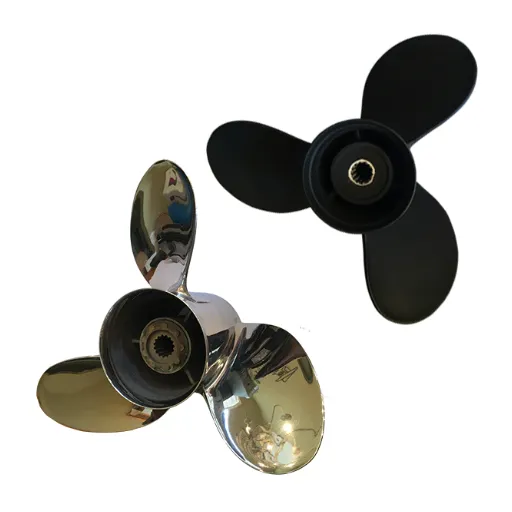
🖤 Yamaha Black Painted Aluminum Propeller
Currently available to us, which offers the efficiency of anodizing and demonstrative quality for durability that Yamaha prides itself on offering. It’s lightweight so it will give you less deadweight yet strengthens, making it a sybaritic affair to maneuver and maintain.
As you look to select the right aluminum propeller for your Yamaha engine, you need to consider engine horsepower, boat size, and the application. These value-for-money options cater to just about everything, delivering the renowned quality of Yamaha without putting a wealth of cash on the line. Whether you’re fishing or just cruising around on the lake, aluminum props provide excellent value for everyday boating fun.
Premium Choices: High-Performance Yamaha Boat Propellers
For hardcore endurance navigators seeking peak ‘on-the-water’ performance, the Yamaha premium propellers are bright favorites. Built from stainless steel, these propellers have high tensile strength and high corrosion-resistant properties—the enviable pontoon panties in the ever-consuming marine environment. Propellers engineered using modern technologies outdo the conventional propellers in acceleration, speed, and fuel efficiency—making performance suitable for speed-boats, competition activities, and heavy-duty applications.
🌊 Yamaha Saltwater Series 2 Propeller
Has a notorious reputation for running heavier boats harder and faster. Specifically designed for demanding saltwater environments with superior corrosion resistance.
🚤 Reliance Propeller
Tailored for improving the mid-range to top end performances for family and sport boats, thereby improving, in the process, general handling and overall ventilation-performance.
🔇 Talon and Ventless Propeller Designs
Commended for spectacles in noise and vibration reduction—such the greatest performance attributes one can reshape and remake. Ultimately, echoless props are greater in-and-out functionality and benefit the lifetime of a boat.
With a premium Yamaha prop installed, there is no questioning the fact that an equipped boater will look with great confidence into the face of any adversity.
Maintenance and Troubleshooting for Yamaha Propellers

Regular Maintenance Tips for Longevity
Regular maintenance is a necessity for keeping the Yamaha propeller going. Start by inspecting the prop for any signs of damage, such as nicks, cracks, or dents, as they can affect the efficiency and fuel efficiency of your engine. Clean it once in a while using a brush or a soft cloth to rid it of any debris, barnacle build-up, and seaweed accrued over time. Besides just maintaining its effectiveness, it also looks after the occurrence of corroded damage.
🔍 Maintenance Checklist
- Visual Inspection: Check for nicks, cracks, dents, or bent blades that can affect performance
- Cleaning: Remove debris, barnacles, and seaweed using a soft brush or cloth
- Shaft Inspection: Periodically remove propeller to check for fishing lines or debris around the shaft
- Lubrication: Apply marine-grade grease to the shaft before reinstallation to prevent corrosion
- Performance Monitoring: Watch for unusual vibrations, noises, or reduced speed/fuel efficiency
- Proper Torque: Use appropriate prop wrench to tighten cone nut to specifications
Another critical step of maintenance includes taking off the propeller periodically to look for fishing lines or any other debris that may get clogged around the shaft. Wrapped fishing lines cause wear to seals, allowing water entry into the lower unit, hence expensive to repair. To avoid this, inspect the propeller hub area and make sure to lubricate the shaft with marine-grade grease prior to reinstallation of the propeller; this may help prevent corrosion another time.
Finally, monitoring its performance is done during regular boating activities. If you experience undue vibrations, unexplainable noises, or whatsoever and a great diminution in your boat speed and fuel efficiency, balancing or repair may be on course. Periodic observations, accompanied by due care, extend the life of one’s Yamaha propeller to the full, making sure it performs dependably in various conditions.
Identifying and Resolving Common Propeller Issues
Addressing the prevalent issues with your Yamaha Propeller, along with these solutions, can enhance the performance of the equipment and extend its life. Here are some general issues and their suggested answers:
⚠️ Propeller Damage
Issue: Physical damage impairs propeller performance—dents, cracks, and bends can slow down or stop boat performance.
Solution: Regular inspection and immediate blade replacement when damage is detected.
💨 Cavitation
Issue: Air bubbles form around the propeller, resulting in loss of thrust and efficiency.
Solution: Verify correct propeller sizing, check for blade damage, and ensure proper engine height.
📳 Vibrations
Issue: Excessive vibrations can indicate physical deformation or imbalance.
Solution: Regular balance checks and professional tuning if vibrations persist.
⚙️ Slipping Issues
Issue: Hub failure causes propeller to “slip”—high RPM without corresponding thrust.
Solution: Replace hub immediately or examine blades for rubber deterioration.
A balanced system of preemptive maintenance, correct upkeep, and knowledgeable settings is your best friend in addressing the most common propeller troubles at once. Keeping abreast of these issues with good information will ensure environmental performance and will augment the long life of the propeller.
When to Replace Your Yamaha Propeller
Certainly, it has always been critical to spot the signs that are indicative of the time to change over my Yamaha propeller. The first of such signs would have to be visibly recognizable damage. If I could see cracks, bent blades, or corrosion on a major scale, it would obviously spell something bad about its performance and fuel economy.
🚨 Signs It’s Time to Replace Your Propeller
- Visible Damage: Cracks, bent blades, or major corrosion visible on inspection
- Performance Issues: Failing to reach maximum speeds or struggling to maintain proper RPM
- Unusual Vibrations: Persistent jerking or vibrations indicating imbalances or structural issues
- Reduced Efficiency: Noticeable decrease in fuel efficiency or boat speed
- Usage Change: Switching boat applications (e.g., from cruising to watersports) may require different propeller specifications
Another critical sign would be the well-known problem of failing in my performance range. At the time when I am getting no max speeds or I am experiencing a burden on maintaining the right RPM or I am finding a jerk here and there, it is a clear sign that the propeller is either worn from the tip or the propeller size is not the best. Sometimes, I trust that I might even examine whether or not the cutter does show some weird vibration while spinning, for that is usually a sign of unchecked imbalances or structure issues calling for my immediate attention.
Lastly, in case of an advanced or a use change in my boat, a Yamaha propeller is the most probable component to require replacement. For example, a change in material or blade design can enhance performance with respect to some operation such trolling or watersports. An ounce of prevention is the best for keeping the boat in good condition at all times so that I can avoid any unexpected stoppage when upon the water.
References
-
Enchanted Tuning Forks: Informal Institutions and Yamaha’s Mysterious Diversion
This document explores Yamaha’s corporate behavior and its motor division, providing in-depth insights into its operations. -
Measurements and Descriptions of Underwater Noise in Finland
This paper includes technical details about Yamaha outboard engines and their underwater noise characteristics. -
Mapping Lake Sturgeon Spawning Habitat in the Upper Tennessee River Using Side Scan Sonar
This study uses Yamaha outboard engines in its methodology, offering practical applications and technical references. -
Small Scale Marine Fisheries: An Extension Training Manual
This manual includes training on outboard engines, including Yamaha, and their applications in marine fisheries. -
Outboard Outlook
This article discusses Yamaha’s shift dampening system (SDS) propellers and their use in various applications. - Click here to read more.
Frequently Asked Questions (FAQ)
❓ How do I choose the right Yamaha propeller for my Yamaha engine?
Yamaha motors range from 50 hp to 350 hp has been designed at a numerous timing and purpose and are installed on the different vessels. All these motors have a distinct propeller match that is very needed. It is important to discuss what you intend to do—any hertler be it is for all kinds of vessels, according to its course.
❓ Which benefits the three-blade propeller over the four-blade propeller in Yamaha outboards?
A 3-blade prop generally fits perfectly with high top speed, light loads, performance-based footprints, walleye fishing boats, bow-fishing boats, and horsepower ratios above 115 in terms of larger boats. The 4-blade prop is the answer to better whoomph or to quickly push the boat with improved handling in times of turns and higher trimming, or even under heavy loads. Continue choosing one according to the size and purpose of your boat: HP or bow tower?
❓ Is there a Yamaha propeller for small engines like t9.9 or for other motors?
The company Maker Yamaha outboard does excellent prop options for small engines such as the t9.9 or other small, low horsepower outboards. With consideration to the tiniest outboard prop diameter, blade area, and cavitation performance as they offer better water while going through turns and have smooth shifting and trolling performance. Please use our propeller guide to determine what size propeller will mount best on your small Yamaha outboard.
❓ Will the SDS design and Michigan Wheel style affect general prop selection?
A new configuration first enables the S-D-S design itself by achieving PVS’s vibration damping plus the incidental damping introduced through growth in hub resilience; this could smooth out your ride and counteract a misunderstood understanding of overloading. The Michigan Wheel angle to durability in this business indicates a purpose-based blade geometry pertinent to Yamaha propellers.
❓ Are the propellers of the f175 and f200 appropriate for my f150 or any other Yamaha outboard?
Propellers could fit between a f150 and an f200, but it is not very common. When buying a prop, one must count the spline on the drive shaft regarding the design of the hub. Check to be sure, before ordering the prop, that the propeller matches with the present hardware. It is strongly recommended that you use our online tool or propeller guide to determine the compatible props for a f150, f175, or f200, thus ensuring incorrect loading and damage.
❓ The effect on propeller choice for Yamaha outboard under heavy loads due to high trim angle?
High-outboard-motors with a heavy rear load require large-area blades and proper pitches to keep ventilation at bay and maintain propeller thrust accordingly. As said, the more water-flow conditions and high-trimed situations in good-turning and four-bladed props ride much more on the rear with excellently-driven-input. Balanced loading must be confirmed by matching your most common running conditions with the right propeller size.
Conclusion
Selecting the right Yamaha outboard propeller is essential for optimizing your boat’s performance, fuel efficiency, and overall boating experience. By understanding the key specifications, performance factors, and maintenance requirements outlined in this guide, you can make an informed decision that matches your specific boating needs. Whether you’re looking for speed, efficiency, or heavy-load capability, Yamaha offers a wide range of propeller options to suit every application. Remember to regularly maintain your propeller and monitor its performance to ensure long-lasting reliability on the water.