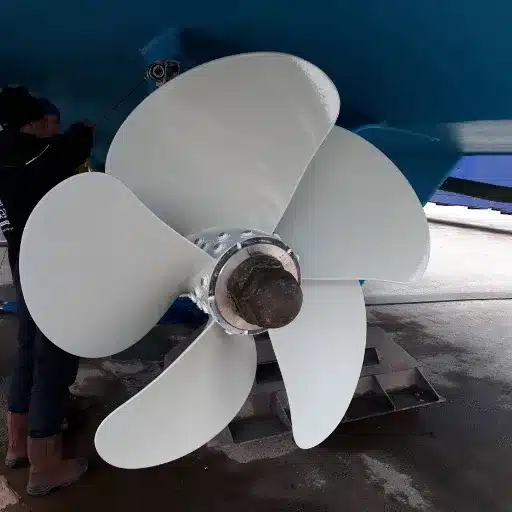
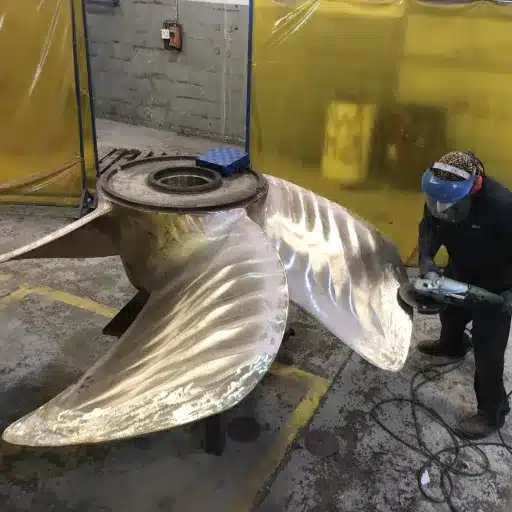
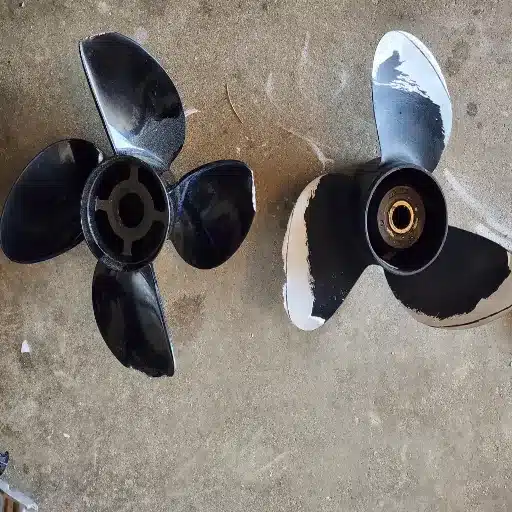
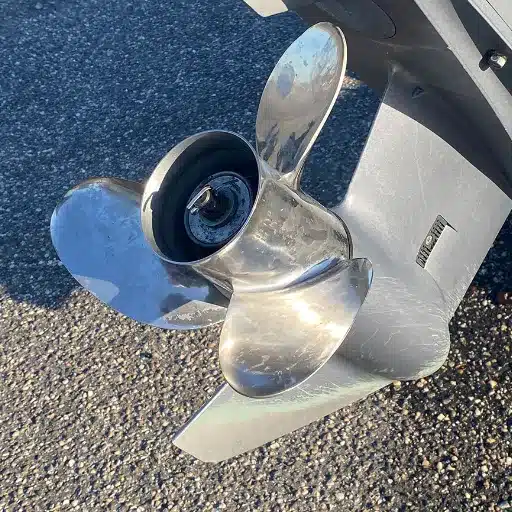
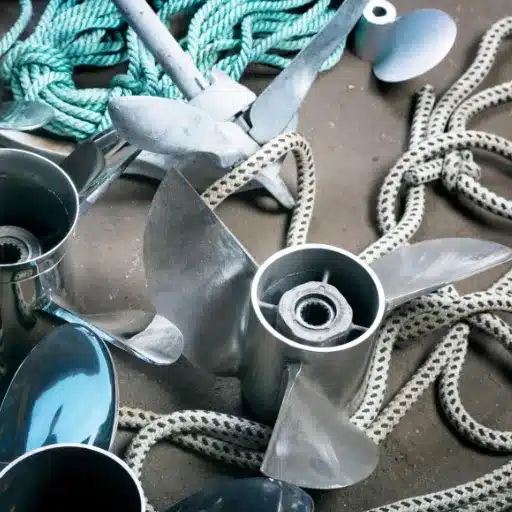
Electric boat propellers are specialized propellers designed for the high-torque, low-RPM characteristics of electric motors. Unlike gas outboards that spin at 5,000 to 6,000 RPM, electric motors typically operate between 800 and 2,000 RPM at cruise. That means the propeller must be larger in diameter, often higher in pitch, and optimized for immediate torque delivery rather than peak horsepower. The result is quieter operation, zero exhaust, and fuel costs that drop to pennies per mile — but only if the propeller is matched correctly.
Most boaters assume they can bolt their old gas prop onto a new electric outboard and call it a day. That is a mistake. The torque curve, RPM range, and shaft speed of an electric motor are fundamentally different from those of a two-stroke or four-stroke outboard. At Captain Marine, we engineer propellers for both gas and electric applications, and the design priorities are not the same. For the complete framework on propeller selection regardless of power source, see our boat propeller selection guide. This article covers what makes electric boat propellers unique, how to size them, and what to expect when you make the switch.
Key Takeaways
- Electric motors deliver maximum torque at zero RPM, so electric boat propellers need larger diameter and aggressive pitch to convert that torque into thrust efficiently
- Most electric outboards spin at 800 to 2,000 RPM at cruise — roughly one-third the speed of a gas outboard — requiring a completely different propeller design
- Battery range depends on hull efficiency, propeller slip, and throttle management; a well-matched prop can extend range by 15 to 25 percent
- Regeneration allows some electric systems to recharge batteries while sailing or coasting, but only with propellers designed for bidirectional flow
- Lifecycle cost analysis usually favors electric after 3 to 5 years when fuel and maintenance savings are factored in
What Are Electric Boat Propellers?
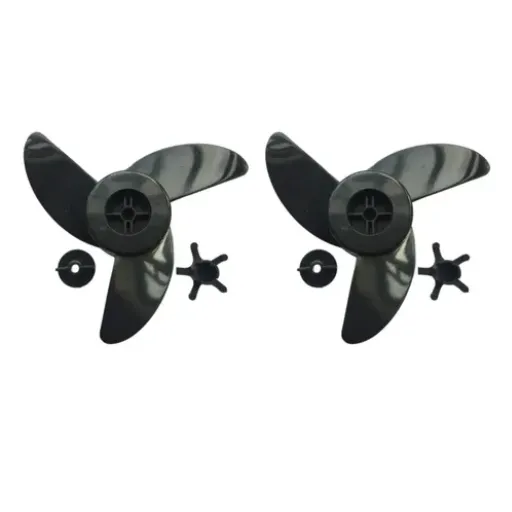
An electric boat propeller is a propeller engineered specifically for the torque, RPM, and power delivery profile of an electric motor. While the basic physics are the same — rotating blades push water aft to move the boat forward — the operating environment is completely different from gas propulsion.
Gas outboards develop peak power in a narrow RPM band, usually 5,000 to 6,000 RPM. The propeller is sized to let the engine reach that band at wide-open throttle. Electric motors, by contrast, develop maximum torque at zero RPM and hold strong torque across a broad range. There is no narrow power band to hit. Instead, the propeller must be designed to convert that instant torque into efficient thrust without overloading the motor or wasting battery capacity.
This difference shows up in three physical characteristics of most electric boat propellers:
- Larger diameter: Because RPM is lower, the propeller needs a larger swept area to move enough water. A 3-horsepower electric outboard might run a 12-inch-diameter propeller that looks like it belongs on a 9.9-horsepower gas motor.
- Higher pitch for the power rating: Electric motors do not need the same pitch reduction at low speed that gas motors do. Many electric props run pitch-to-diameter ratios that would lug a gas engine.
- Different blade geometry: Electric propellers often use wider blades with more cup to reduce slip at low RPM. The goal is to grab water immediately when the throttle is applied, which matches the instant torque profile of the motor.
Materials matter too. While aluminum and stainless steel are both used on electric props, composite and carbon-fiber designs are more common in the electric market because they reduce weight and corrosion risk. For a detailed comparison of propeller materials and how they affect performance, read our guide on aluminum vs stainless steel propellers.
How Electric Propulsion Differs from Gas
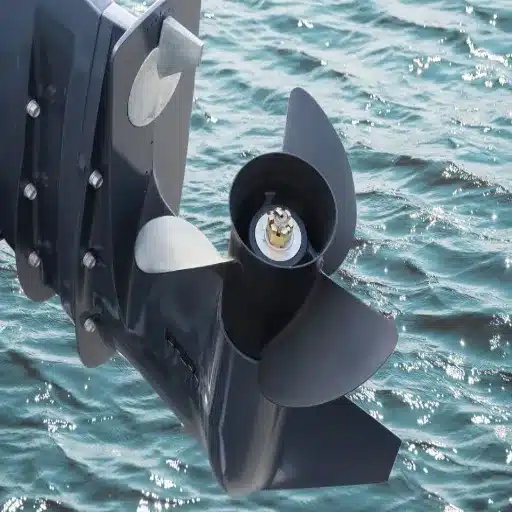
Torque Curves: The Fundamental Difference
A gas outboard builds torque gradually. At idle, it produces almost no usable torque. At 3,000 RPM, it is waking up. At 5,500 RPM, it hits peak power. The propeller is sized to let the engine spin fast enough to reach that peak.
An electric motor is the opposite. It produces 100 percent of its rated torque at zero RPM. When you advance the throttle, the full twisting force hits the propeller shaft immediately. There is no spool-up, no power band, and no need to downshift or trim for a hole shot. The boat simply goes.
This instant torque is electric propulsion’s biggest advantage — and its biggest sizing challenge. A propeller that is too small will let the motor spin too fast, wasting energy as heat and noise instead of thrust. A propeller that is too large will overload the motor, drawing excessive amperage and draining the battery faster than necessary.
RPM Ranges and Gear Reduction
Most electric outboards use direct drive or a single-stage gear reduction. There is no gearbox with multiple ratios, no clutch, and no trim-adjustable lower unit. The propeller shaft turns at a fixed ratio relative to the motor, usually between 800 and 1,200 RPM at cruise.
Gas outboards use much steeper gear reduction — typically 1.85:1 to 2.33:1 — to let the engine spin fast while the propeller spins slowly. Even then, the propeller still turns at 2,500 to 3,000 RPM at cruise. An electric propeller might cruise at 900 RPM. That difference changes everything about blade loading, cavitation margins, and slip calculations.
When Mike switched his 20-foot center console from a 90-horsepower Yamaha to a 10-kilowatt electric outboard, he bolted on the same 13.25-by-17-pitch stainless prop he had been running for three seasons. At full throttle, the electric motor spun the prop to only 1,200 RPM — far below its designed operating range. The boat topped out at 9 MPH instead of the 22 MPH the electric motor was capable of. Mike thought the motor was underpowered until a prop shop explained that his propeller was sized for 5,500 RPM, not 1,200. A switch to a 15.5-inch-diameter prop with a 21-inch pitch brought his top speed to 20 MPH and cut his amperage draw by 30 percent. The wrong prop had been strangling the motor.
Electric Propeller Sizing and Pitch Selection
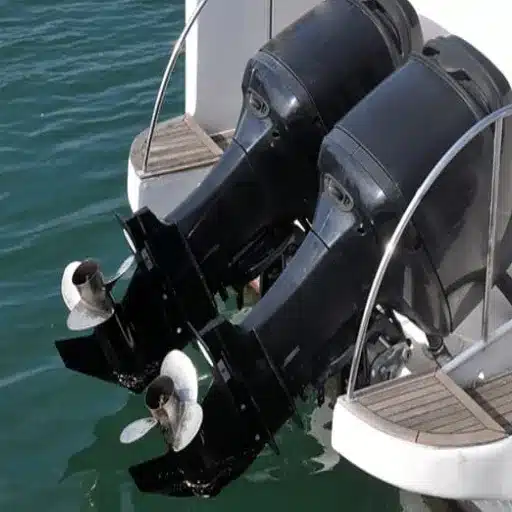
Why Standard Gas Sizing Charts Do Not Work
Gas propeller sizing charts are built around horsepower and WOT RPM. You look up your engine’s horsepower, find the recommended diameter range, and choose a pitch that lets the engine reach its rated RPM at full throttle.
Electric motors do not use horsepower in the same way. A 10-kilowatt electric motor is roughly equivalent to 13.4 horsepower, but it does not behave like a 15-horsepower gas outboard. It behaves like a much larger motor at low speed and a smaller motor at high speed. Sizing charts that rely on horsepower alone will mislead you.
The better approach for electric propeller sizing is to work from thrust and current draw:
- Measure the motor’s rated continuous torque in newton-meters or foot-pounds.
- Calculate the theoretical thrust at your target cruise RPM using the propeller’s pitch and diameter.
- Match propeller load to motor efficiency curve — most electric motors are most efficient at 70 to 85 percent of max RPM.
- Verify current draw at cruise — if the motor pulls more than 80 percent of its rated continuous amperage, the prop is too large.
Pitch for Electric Motors
Pitch on an electric propeller works the same way it does on a gas prop — one inch of pitch moves the boat forward one inch per revolution in a perfect fluid. But because electric motors spin more slowly, the effective pitch needs to be higher to achieve the same speed at a given RPM.
Rule of thumb for electric outboards: start with a pitch that is 2 to 4 inches higher than what the equivalent gas outboard would use. A 10-kilowatt electric motor replacing a 15-horsepower gas outboard might need a 19-pitch or 21-pitch prop instead of the 15-pitch or 17-pitch the gas motor ran.
Slip is another factor. Gas propellers typically run at 10 to 20 percent slip. Electric propellers, because they turn slower and have larger-diameter blades, often run at 15 to 25 percent slip. That means a 21-pitch electric prop at 1,000 RPM with 20 percent slip gives a theoretical speed of roughly 17 MPH, not 21 MPH.
Types of Electric Boat Motors and Propeller Compatibility

Electric Outboards
Electric outboards from brands like ePropulsion, Torqeedo, and Mercury Avator mount on the transom like a gas outboard. They use a tiller or remote steering and typically range from 1 to 100+ kilowatts. Propellers for these motors are usually proprietary to the brand — the hub, spline, and gearcase are integrated — but aftermarket options are growing.
Torqeedo uses a foldable propeller design on many models. The blades fold back against the hub when the motor is off, reducing drag under sail. ePropulsion uses fixed-pitch aluminum props with aggressive cupping for low-speed thrust. Mercury’s Avator line uses a custom propeller designed specifically for its direct-drive lower unit.
Pod Drives and Inboards
Pod drives like the Torqeedo Cruise or ePropulsion Pod Drive mount through the hull and drive a conventional shaft. These systems often use larger, slower-turning propellers that look more like inboard props than outboard props. Diameter is king here — a 16-inch or 18-inch propeller turning at 500 to 800 RPM is common.
Because pod drives usually lack a gearbox, the propeller must be sized to load the motor correctly across the entire RPM range. Some manufacturers offer two-blade folding props for sailing efficiency and three-blade fixed props for motoring efficiency.
Trolling Motors
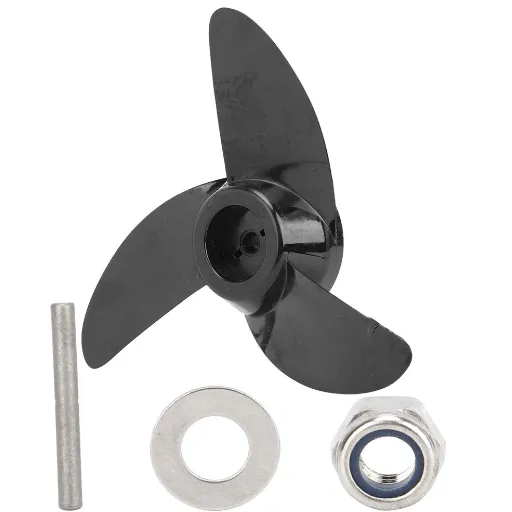
Electric trolling motors are the most common form of electric propulsion in recreational boating. They use small-diameter, high-RPM propellers designed for low-speed thrust and precise boat control. These props are not interchangeable with outboard or pod-drive props — the hub, shaft, and RPM are completely different.
Trolling motor props emphasize weed resistance and low-speed bite over top-end efficiency. Many use two-blade designs with swept-back leading edges to shed vegetation. Upgrading to a stainless or composite trolling prop can improve runtime by 10 to 15 percent on the same battery.
Battery Capacity, Range, and Efficiency
The Math Behind Electric Range
Battery capacity is measured in kilowatt-hours (kWh). A 5-kWh battery running a 2-kilowatt motor at cruise will last roughly 2.5 hours. If that motor pushes the boat at 5 MPH at that throttle setting, the range is 12.5 miles. It is simple math, but the real world adds complexity.
Hull drag increases with the square of speed. Doubling your speed quadruples drag, which means the motor draws four times as much power. That is why electric boats have a sweet spot — usually 60 to 70 percent of hull speed — where range is maximized. Pushing past that point drains the battery exponentially faster.
The propeller’s role in this equation is efficiency. A poorly matched prop creates excess slip, which wastes energy as turbulence instead of thrust. A well-matched prop converts more of the motor’s electrical input into forward motion. The difference between a mismatched prop and an optimized prop can be 15 to 25 percent in range.
Hull Efficiency Factors
Not all hulls are equal for electric propulsion. Displacement hulls — like sailboats and trawlers — are naturally efficient at low speed and make excellent electric candidates. Planing hulls require more power to get over the hump and onto plane, which demands larger battery banks.
| Hull Type | Typical Efficiency at Cruise | Electric Suitability |
|---|---|---|
| Displacement (sailboat, trawler) | High | Excellent — long range on small batteries |
| Semi-displacement (pontoon, small cruiser) | Moderate | Good — moderate range, sweet spot at 5 to 8 MPH |
| Planning (runabout, bass boat) | Low at planning speeds | Fair — requires a large battery bank for speed |
When Lisa bought a 22-foot pontoon with a 6-kilowatt electric outboard, she assumed the rated 4-hour runtime meant 4 hours at any speed. On her first lake trip, she ran at 75 percent throttle to keep up with friends. The battery died in 90 minutes. After recalculating her cruise speed to 60 percent throttle — about 5.5 MPH — she got 3.5 hours of runtime and still had 20 percent reserve. The propeller was already well matched, but her throttle management was not. Range is a function of speed, hull drag, and propeller efficiency together.
Regeneration: Can Your Propeller Charge Your Battery?
How Propeller Regeneration Works
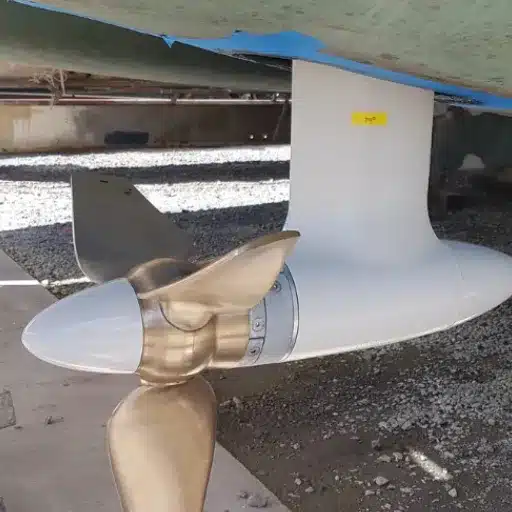
Some electric propulsion systems — primarily those on sailboats — offer regeneration. When the boat is moving through the water under sail, the propeller spins freely. If the motor controller is designed for it, the spinning propeller drives the motor as a generator, converting water flow into electrical current that charges the battery.
It sounds like free energy, but it is not. The drag created by the spinning propeller slows the boat slightly. On a sailboat doing 6 knots, regeneration might produce 100 to 300 watts while shaving 0.2 to 0.5 knots off boat speed. For a cruiser spending hours under sail, that is a meaningful trickle charge. For a powerboat, it is irrelevant.
Propeller Requirements for Regeneration
Not all propellers work for regeneration. Fixed three-blade props generate the most drag and the most power. Folding props generate less drag when folded, but they must be designed to lock open under regenerative load. Two-blade folding props often will not generate enough torque to spin the motor efficiently.
If regeneration is a priority, choose a propeller that the motor manufacturer specifically rates for the purpose. Torqeedo, Oceanvolt, and ePropulsion all publish regeneration curves for their approved propellers. Using an unapproved prop can damage the motor controller or produce a negligible charge.
Maintenance and Durability

What Electric Propellers Need — and What They Do Not
Electric propellers have fewer maintenance demands than gas propellers because there is no lower unit oil, no exhaust residue, and no fuel system to contaminate the waterline. The propeller itself still needs attention, but the routine is simpler.
After every use in saltwater: Rinse the propeller with fresh water. Salt crystallizes on the blade surfaces and hub, which creates micro-pitting over time. Electric motors are often used in environmentally sensitive areas where corrosion inhibitors are restricted, so rinsing is your best defense.
Monthly: Inspect the propeller for nicks, cracks, and fishing line. A line wrapped around the prop shaft can damage the motor’s seals just as easily as it damages a gas outboard’s lower unit. Because many electric motors have integrated electronics near the prop shaft, water intrusion can be more expensive to repair than a gearcase rebuild.
Seasonally: Remove the propeller, clean the shaft splines, and apply marine grease. Check the prop nut torque. Electric motors produce high instant torque, which can loosen a prop nut faster than the gradual torque buildup of a gas engine.
Composite and carbon-fiber electric props need UV protection. Store them out of direct sunlight when not in use. UV degrades the resin matrix and can lead to blade delamination over time.
Cost Analysis: Electric vs Gas Over Time
Upfront Investment
Electric propulsion costs more upfront. A 10-kilowatt electric outboard with a battery bank runs $4,000 to $8,000, while a comparable 15-horsepower gas outboard runs $2,500 to $4,000. The gap is narrowing as battery prices fall, but electric vehicles still command a premium.
Operating Costs
Electricity is cheaper than gasoline. At $0.15 per kWh, a 5-kWh battery costs $0.75 to charge. At $3.50 per gallon, a 5-gallon tank costs $17.50. If a gas outboard burns 1 gallon per hour and an electric motor draws 2 kW per hour, the electric motor costs $0.30 per hour to run versus $3.50 per hour for gas. Over 100 hours of runtime, that is $30 versus $350.
Maintenance Savings
Electric motors have no oil changes, no spark plugs, no fuel filters, and no winterization beyond battery storage. Annual maintenance savings typically run $200 to $400 compared to a gas outboard. Propeller maintenance is similar for both, though electric props may need less frequent replacement due to lower operating RPM and less cavitation.
The Breakeven Point
Dave ran the numbers on his 22-foot runabout after switching to a 25-kilowatt electric outboard. The electric package cost $6,000 more than the gas alternative he had considered. He saved $320 per year on fuel, $250 per year on maintenance, and $150 per year on winterization. At $720 per year in total savings, his breakeven point was 8.3 years. Then gas prices spiked, his marina raised winter storage rates, and his actual savings hit $950 per year. His payback dropped to 6.3 years. For Dave, who plans to keep the boat for 10 years, the switch was a clear financial win.
| Cost Category | Gas Outboard (Annual) | Electric Outboard (Annual) | Savings |
|---|---|---|---|
| Fuel/Electricity | $350 | $30 | $320 |
| Routine maintenance | $300 | $50 | $250 |
| Winterization/storage | $200 | $50 | $150 |
| Total | $850 | $130 | $720 |
Frequently Asked Questions
Do electric boats need special propellers?
Yes. Electric motors spin slower and produce instant torque, so the propeller must be larger in diameter and often higher in pitch than a gas prop of equivalent power. Using a gas propeller on an electric motor usually results in poor efficiency, low top speed, and excessive battery drain.
Can I use my old gas propeller on a new electric outboard?
Usually no. Most electric outboards use proprietary hub designs, splines, and gearcase configurations that are not compatible with standard gas propellers. Even when the hub fits, the blade geometry is wrong for the motor’s torque and RPM profile.
How do I size a propeller for an electric motor?
Work from the motor’s torque curve and target cruise RPM, not horsepower. Match the propeller load to the motor’s efficiency range — typically 70 to 85 percent of max RPM. Verify that the current draw at cruise stays below 80 percent of the motor’s continuous rating.
What is the range of an electric boat?
Range depends on battery capacity, hull efficiency, speed, and propeller match. A well-optimized displacement hull with a 10-kWh battery might cruise for 20 to 30 miles at 5 MPH. A planning hull at 20 MPH might drain the same battery in under an hour.
Does propeller material matter for electric motors?
Yes. Aluminum, stainless steel, and composite all work, but composite props are popular in electric applications because they reduce weight and eliminate galvanic corrosion. The material choice should match your boating environment and performance goals.
Can any electric propeller regenerate power?
No. Regeneration requires a motor controller designed for it and a propeller that produces enough drag to spin the motor as a generator. Folding props, two-blade designs, and high-speed props often do not generate meaningful regenerative current.
Are electric propellers more efficient than gas propellers?
Electric propulsion systems are inherently more efficient at converting energy to thrust — roughly 80 to 90 percent versus 30 to 40 percent for gas. However, the propeller itself must be designed for the motor’s RPM and torque. A mismatched electric propeller can waste just as much energy as a mismatched gas propeller.
How much does an electric boat propeller cost?
Electric propellers range from $50 for a basic trolling motor prop to $500+ for a high-end stainless or composite outboard prop. Most electric outboard manufacturers include a propeller with the motor, but aftermarket upgrades are available for better performance or efficiency.
Will an electric motor damage a propeller designed for gas?
Not immediately, but the efficiency will be poor. The electric motor’s instant torque can also stress blades that were designed for gradual torque buildup. If the prop is too small, the motor may over-rev, which can strain the hub and bearings.
What maintenance does an electric propeller need?
Rinse after saltwater use, inspect monthly for damage and fishing line, grease the shaft splines seasonally, and check prop nut torque more frequently than you would on a gas motor due to the instant torque delivery.
The Bottom Line
Electric boat propellers are not just gas props with a different hub. They are engineered for a fundamentally different power delivery profile — high torque, low RPM, and instant response. Getting the diameter, pitch, and blade geometry right means the difference between a boat that sips battery and glides quietly across the water, and a boat that struggles to reach hull speed while draining its pack in an hour.
If you are converting a boat from gas to electric, do not reuse your old propeller sizing assumptions. Start fresh with the motor’s torque curve, target cruise RPM, and hull efficiency. The math is straightforward, but the answers are different.
At Captain Marine, we design propellers for both gas and electric applications. If you are unsure whether your current prop is optimized for your electric motor, send us your motor specs, hull type, and current prop markings. Our engineering team will confirm you have the right propeller for quiet, efficient electric cruising.