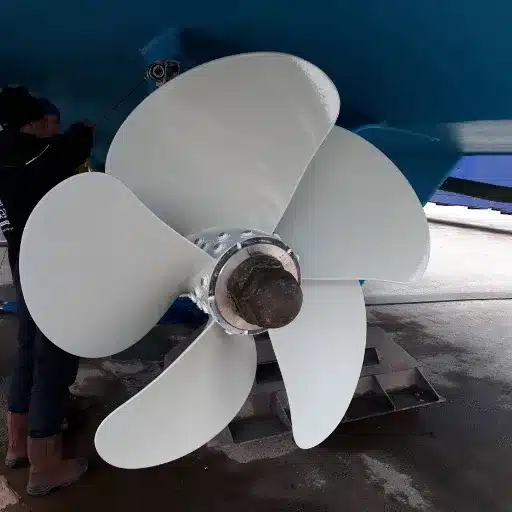
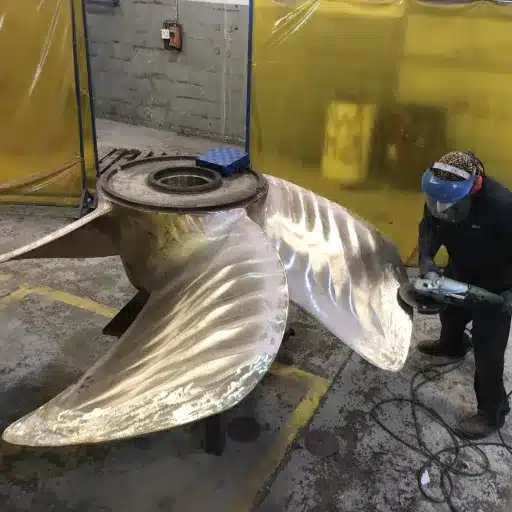
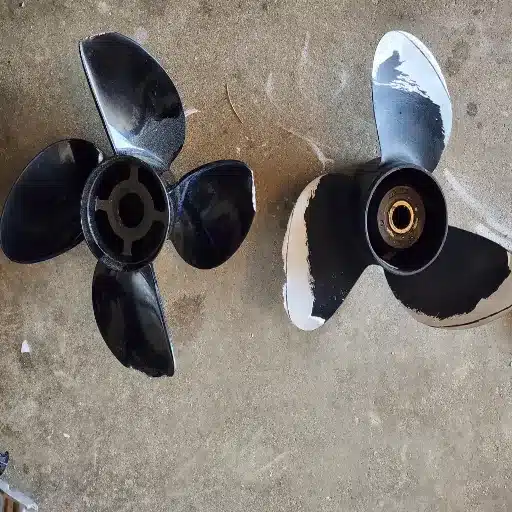
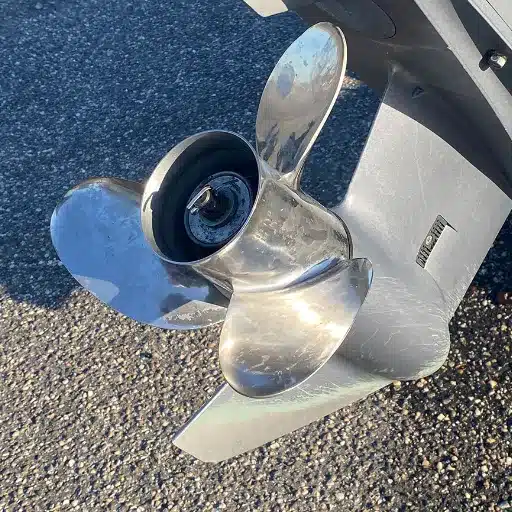
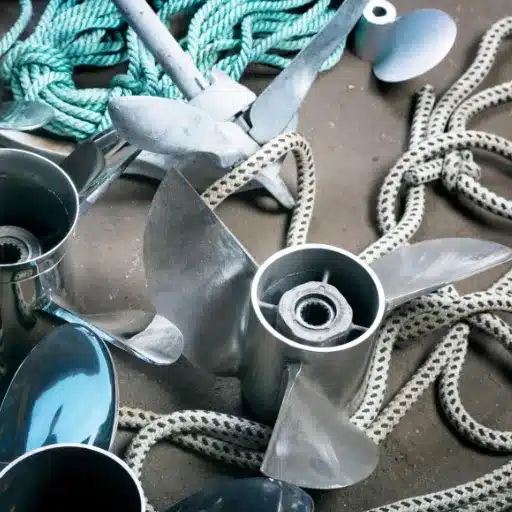
Propeller cupping is a small lip rolled into the trailing edge of each blade that increases effective pitch and reduces air ingestion. Propeller rake is the angle of the blade tip relative to the hub, measured in degrees, which determines whether the propeller lifts the bow or the stern. Together, cupping and rake are the two most misunderstood tuning variables on a boat — and the two that can transform handling without changing diameter, pitch, or material.
Most boaters shop for props by diameter and pitch alone. They ignore the cup and rake because the spec sheets do not explain them in plain English. The result is a boat that planes at the wrong angle, loses bite in turns, or ventilates in chop — all because the propeller geometry does not match the hull. At Captain Marine, we use cupping and rake as fine-tuning tools after the basic diameter and pitch are correct. For the complete framework on choosing the right propeller from the start, see our boat propeller selection guide. This article breaks down exactly what cupping and rake do, how they interact, and how to choose the right combination for your hull.
Key Takeaways
- Propeller cupping increases effective pitch by roughly 1 inch and creates a pocket that resists air ingestion
- Propeller rake determines whether the prop lifts the bow (high rake) or the stern (low rake), changing the boat’s planing attitude
- More cup improves hole shot and reduces ventilation but can cost 1 to 3 MPH at the top end
- High-rake props improve top speed and bow lift on performance hulls but increase steering torque
- Cupping and rake are tuning tools, not replacements for correct diameter and pitch
What Is Propeller Cupping?
The Physics in Plain English
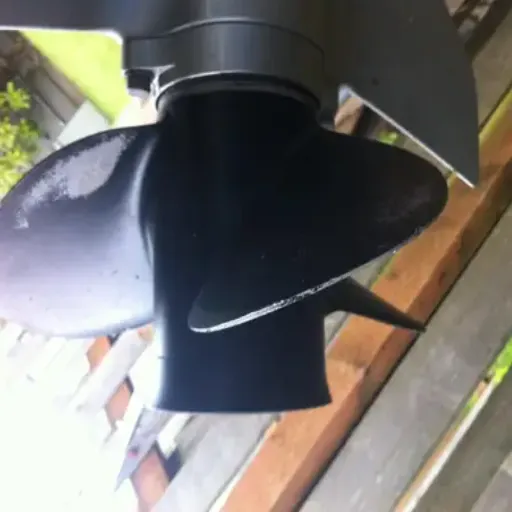
Cupping is a slight bend — typically 1/16 to 3/16 of an inch — rolled into the trailing edge of each propeller blade, on the blade face side. When you look at a cupped blade from the side, the trailing edge curves away from the boat like a tiny scoop. That scoop does two things.
First, it increases the effective pitch of the propeller. A 21-pitch prop with cupping behaves like a 22-pitch prop without cupping. The cup traps water against the blade face for a fraction of a second longer, which pushes more water aft per revolution. The engine feels the extra load. The boat gets more thrust. For a deeper look at how pitch drives performance, read our guide on what the best propeller pitch is for my boat.
Second, the cup creates a pressure pocket that resists air ingestion. When a blade tip nears the surface in a turn or in rough water, the cup holds water against the blade instead of letting surface air slip in. This is why cupped props ventilate less than non-cupped props at the same trim angle.
What Does Propeller Cupping Look Like?
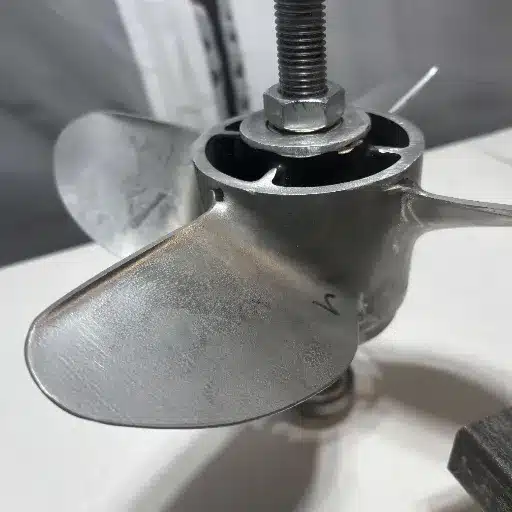
On a new prop, cupping is subtle. Hold the prop with the blade face toward you and sight down the trailing edge. A cupped blade will show a slight concave curve at the trailing edge, usually deepest at the tip and fading toward the hub. On stainless steel props, the cup is often machined in with a CNC cutter. On aluminum props, it is stamped during casting.
The number of cups varies by manufacturer and application:
| Cup Amount | Typical Application | Performance Effect |
|---|---|---|
| No cup (0″) | Economy outboards, trolling motors | Standard pitch behavior, more ventilation risk |
| Light cup (1/16″) | General recreational boating | Slight bite improvement, minimal speed loss |
| Medium cup (1/8″) | Performance runabouts, bass boats | Better hole shot, reduced ventilation, ~1″ effective pitch increase |
| Heavy cup (3/16″+) | High-performance boats, offshore hulls | Maximum bite, strongest ventilation resistance, ~1.5-2″ effective pitch increase |
How Cupping Affects RPM
Cupping loads the engine more than the stamped pitch suggests. Rule of thumb: each 1/16 inch of cup adds roughly 150 to 200 RPM of load at WOT. If you switch from a non-cupped 21-pitch prop to a cupped 21-pitch prop with 1/8 inch of cup, expect your WOT RPM to drop by 300 to 400. That is the equivalent of jumping from a 21-pitch to a 22-pitch or 22.5-pitch prop.
This is why cupping is a tuning tool, not a starting point. You choose the correct diameter and pitch first. Then you add or remove a cup to fine-tune the RPM into the manufacturer-specified range. For a deeper technical explanation of how cupping is machined into propeller blades, Michigan Wheel covers the manufacturing process in their propeller cupping guide.
What Is Propeller Rake?
Defining Rake Angle
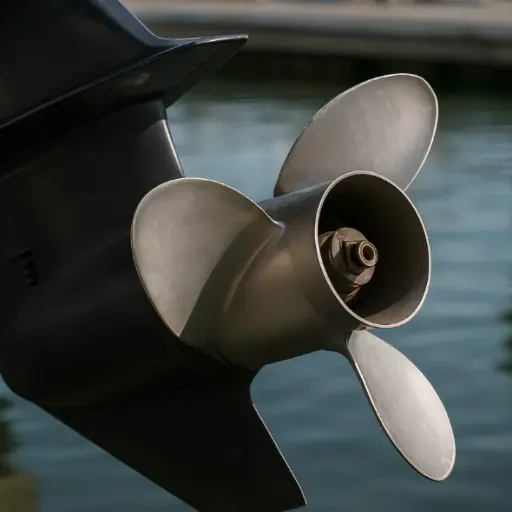
Rake is the angle of the blade tip relative to the hub centerline, measured in degrees. A blade with zero rake sits perpendicular to the hub, like a paddle wheel. A blade with positive rake angles aft, meaning the tips point toward the stern. A blade with negative rake angles forward, meaning the tips point toward the bow.
Most modern propellers use positive rake. The typical range is 10 to 30 degrees. Higher-rake props point the blade tips farther aft, which changes the direction of thrust and alters how the hull rides on the water.
How Rake Affects Bow Lift and Stern Lift
Here is the part most boaters miss: rake does not just change thrust. It changes where the thrust is applied relative to the hull’s center of gravity.
A high-rake propeller — 20 to 30 degrees — directs thrust more horizontally and pushes the stern down slightly. That lever action lifts the bow. The boat planes with a flatter attitude, the bow rides higher, and the hull encounters less wetted surface. The result is usually a higher top speed and a drier ride in chop.
A low-rake propeller — 10 to 15 degrees — directs thrust more vertically relative to the hull. It pushes the stern up, which drops the bow. The boat planes with more bow in the water, which improves stability and hole shot but increases wetted drag.
| Rake Type | Angle Range | Effect on Hull | Best For |
|---|---|---|---|
| Low rake | 10-15 degrees | Stern lift, bow down | Pontoon boats, heavy cruisers, ski/wake boats |
| Medium rake | 15-20 degrees | Balanced attitude | General runabouts, fishing boats |
| High rake | 20-30 degrees | Bow lift, stern down | Bass boats, performance hulls, offshore center consoles |
Steering Torque and Rake
High-rake props create more steering torque. Because the blades are angled aft, the water leaving the propeller has a rotational component that pushes against the lower unit skeg. The helmsman feels this as a heavier steering effort, especially at low speed. Hydraulic steering or power assist becomes more important on boats running high-rake props.
Low-rake props steer lighter. The water exits more axially, with less rotational swirl against the skeg. This is one reason pontoon boats and cruisers — which value easy handling over outright speed — often run low-rake designs.
Propeller Cupping vs Rake: How They Work Together
The Interaction Effect
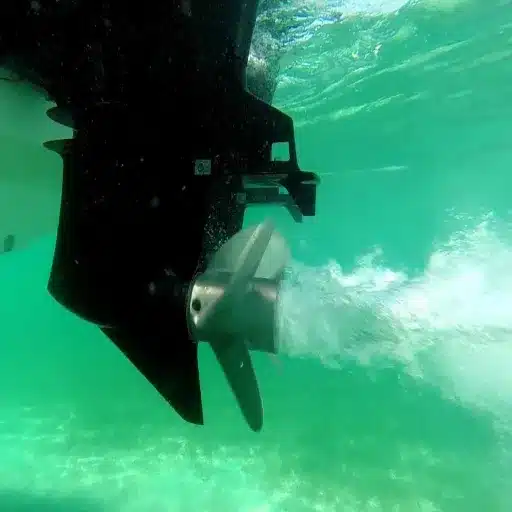
Cupping and rake are independent variables, but they interact in ways that matter on the water. A high-rake prop with heavy cupping creates a powerful combination: the rake lifts the bow for speed, and the cup holds water against the blade to prevent ventilation in the aerated water behind a lifted bow.
A low-rake prop with light cupping does the opposite. It keeps the bow down for stability, and the minimal cup reduces load on the engine so the boat can plane quickly with a heavy load.
| Combination | Planing Attitude | Ventilation Resistance | Best Application |
|---|---|---|---|
| High rake + heavy cup | Bow up, flat ride | Excellent | Bass boats, high-speed runabouts |
| High rake + light cup | Bow up, some slip risk | Good | Offshore center consoles in calm water |
| Low rake + heavy cup | Bow down, strong bite | Good | Pontoon boats in rough water |
| Low rake + light cup | Bow down, easy steering | Moderate | Ski/wake boats, family cruisers |
When Cupping Compensates for Rake
Sometimes a propeller has too much rake for the hull. The bow lifts so high that the propeller tips near the surface and ventilates. Instead of reducing rake — which would require a new prop — you can add cupping. The cup holds water at the trailing edge and extends the effective blade depth, delaying ventilation without changing the rake angle.
This is common on bass boats that run high-rake props for speed but occasionally hit chop that lifts the stern. A few thousandths of an inch of additional cup can cure the ventilation without sacrificing the bow-lift benefit of the high rake.
How Cupping Affects Performance
Hole Shot and Acceleration
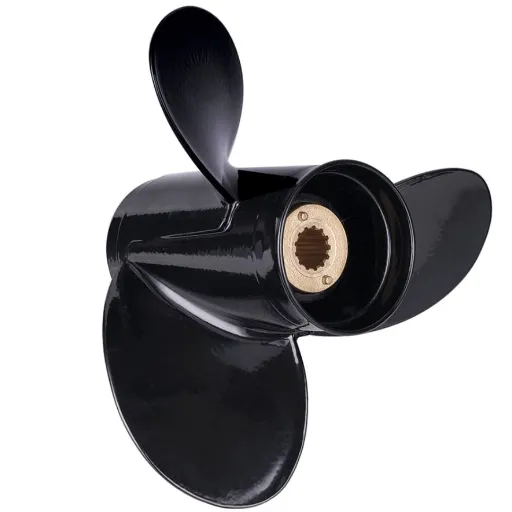
Cupping improves hole shot — the time from idle to plane — because the cupped blade traps more water at low RPM. At low speed, the propeller is moving slowly, and the blades are not generating much hydrodynamic lift. The cup acts like a mini-scoop that grabs water and pushes it aft even when the blade angle of attack is shallow.
When Marcus swapped the standard prop on his 19-foot Tahoe runabout for a cupped version with the same stamped pitch, his hole shot improved by roughly 2 seconds. The boat planed at 14 MPH instead of 17 MPH, which made a real difference when pulling tubers and wakeboarders out of the water. He lost 1 MPH at the top end, but for a family boat, the tradeoff was worth it.
Top Speed Tradeoffs
Cupping is not free. The extra load it places on the engine means the motor cannot spin as fast at WOT. A heavily cupped prop may drop top speed by 1 to 3 MPH compared to a non-cupped prop of the same stamped pitch. On a performance bass boat chasing tournament speeds, that tradeoff matters. On a pontoon boat or cruiser, it rarely does.
Ventilation Resistance
This is where cupping shines. In turns, rough water, or when trimmed aggressively, the blade tips approach aerated water near the surface. The cup creates a pressure barrier that resists air ingestion. A prop with 1/8 inch of cup will typically ventilate 20 to 30 percent less than an identical prop without a cup in the same conditions.
Fuel Efficiency
The effect of cupping on fuel economy is mixed. At cruise RPM, a cupped prop often runs more efficiently because it holds water better and reduces slip. At WOT, the extra load can raise fuel burn. Most recreational boaters see a slight improvement in cruise MPG and a slight drop in WOT GPH after adding cup.
How Rake Affects Performance

Planning Attitude and Hull Efficiency
A rake is the primary tool for adjusting how a hull rides on the water. A hull that planes with the bow too high feels loose in turns and takes longer to get on plane. A hull that planes with the bow too low pushes water and feels sluggish. The right rake puts the hull at its designed trim angle.
When Lisa bought her 22-foot center console, it came with a 19-degree rake prop that lifted the bow beautifully at 35 MPH. But at trolling speed, the bow rode so high that she lost sight of structure on her fishfinder. She swapped to a 15-degree rake prop of the same pitch and diameter. The bow settled 3 to 4 inches lower at idle, her trolling visibility improved, and she only lost 1 MPH at the top end.
Top Speed and Slip
High-rake props generally produce higher top speeds on planing hulls because they reduce wetted surface. By lifting the bow, they let the hull ride on less of its bottom, which cuts drag. On stepped hulls and performance vee-bottoms, high rake is almost mandatory for maximum speed.
The tradeoff is increased propeller slip at low speed. The angled blades do not grip as effectively when the boat is still displacing water. Hole shot suffers slightly compared to a low-rake prop of the same pitch.
Handling in Turns
Rake changes how the boat behaves in hard turns. High-rake props tend to let the bow drop in turns because the hull’s natural lean compresses the stern and reduces the rake’s bow-lift effect. The boat may feel like it is digging in. Low-rake props keep the bow more consistent through the turn but can make the boat feel bow-heavy.
Cupping and Rake by Boat Type
Bass Boats
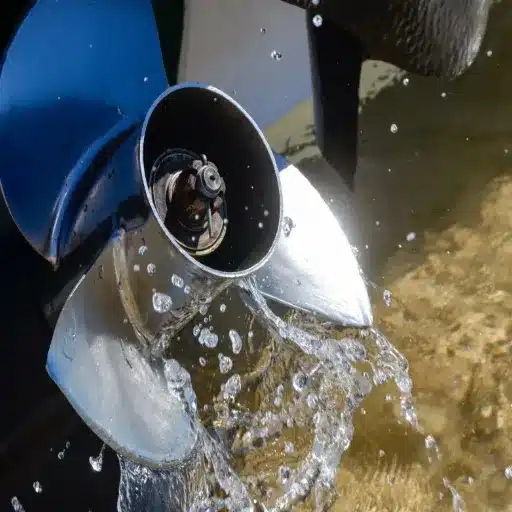
Bass boats need a bow lift for speed and cupping for bite in turns. Most tournament rigs run high-rake props (20 to 30 degrees) with medium to heavy cup (1/8 to 3/16 inch). The high rake gets the bow up for 50+ MPH runs across the lake. The cup prevents ventilation when the driver whips the boat into a tight turn at the next waypoint.
Pontoon Boats
Pontoon boats are the opposite. They need a stern lift to get the heavy deck on the plane, and they need low steering effort for dock maneuvering. Most pontoons run low-rake props (10 to 15 degrees) with light to medium cup (1/16 to 1/8 inch). The low rake keeps the bow down and the deck stable. The cup helps the propeller bite through the aerated water behind the pontoons.
Ski and Wake Boats
Ski boats need a consistent pull at low speed and minimal bow rise during acceleration. Low-rake props with minimal cup keep the bow down and the pull steady. Wake boats sometimes run slightly more rake to lift the stern and create a larger wake, but cupping is usually light to preserve smooth acceleration.
Offshore Center Consoles
Offshore hulls encounter real chop. They need enough rake to keep the bow up and dry, but not so much that the prop ventilates in following seas. Most offshore boats run a medium rake (15 to 20 degrees) with a medium cup (1/8 inch). The combination gives a flat ride in head seas and enough bite to maintain speed in a quartering sea.
Cruisers and Runabouts
Family cruisers prioritize comfort and fuel efficiency over outright speed. Medium rake (15 to 18 degrees) with light cup (1/16 inch) is the standard setup. It gives a balanced ride, easy steering, and good cruise MPG without the aggressive bow lift of a performance prop.
When to Upgrade to a Cupped Propeller
Signs Your Boat Needs More Cup
- The engine ventilates in moderate turns or light chop, even with conservative trim
- WOT RPM is 200 to 400 above the manufacturer spec, despite the correct stamped pitch
- The propeller feels like it is slipping when you accelerate from idle
- You want a better hole shot without changing the diameter or pitch
Signs Your Boat Needs Less Cup
- WOT RPM is 200 to 400 below spec and the engine sounds labored
- Top speed dropped after installing a cupped prop with the same stamped pitch
- The boat struggles to reach the plane with a normal load
Signs Your Boat Needs More Rake
- The bow rides low and pushes water at cruise speed
- You want a higher top speed, and the engine has RPM headroom
- The boat feels bow-heavy in turns
Signs Your Boat Needs Less Rake
- The bow rides too high, reducing visibility and trolling stability
- Steering effort is excessive at low speed
- The boat feels loose or twitchy at high speed
Case Studies: Cupping and Rake in the Real World
Case 1: Bass Boat — Too Much Rake, Not Enough Cup
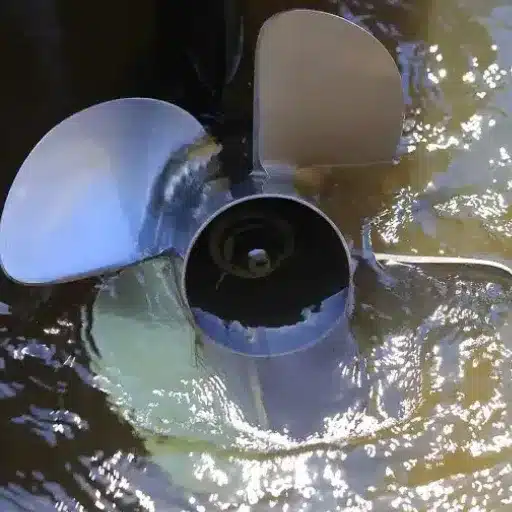
Tom runs a 20-foot Skeeter with a 250 HP Yamaha on a Tennessee reservoir. His prop was a 25-degree rake, 23-pitch stainless prop with no cup. At 55 MPH on flat water, the boat was fast and dry. But in the tight turns he needed for fishing brush piles, the prop ventilated every time he cut the wheel hard. The RPM would spike 600 to 800, and the boat would lose steering bite for 2 to 3 seconds.
We kept the same rake and pitch but added 1/8 inch of cup to the trailing edge. The ventilation in turn, disappeared completely. WOT RPM dropped from 6,100 to 5,850 — right in the middle of the Yamaha spec. Top speed fell from 55 to 54 MPH, but Tom said the improved handling in turns was worth far more than the 1 MPH loss. Cost: $120 for cupping at a prop shop.
Case 2: Pontoon Boat — Wrong Rake for the Hull
Karen owns a 24-foot Bennington with a 150 HP Mercury. Her dealer had installed a 20-degree rake prop because it was in stock. The pontoon planed fine with a light load, but with 10 passengers and a cooler, the bow rode so high that the front deck felt unsafe in chop. The high rake was lifting a hull that did not need bow lift.
We swapped her to a 12-degree rake prop with the same 19-pitch and 14.25-inch diameter. The bow settled immediately. The boat planed 2 MPH sooner with a heavy load. Steering effort at the dock dropped noticeably. She lost 2 MPH at the top end, but her typical cruise speed — 22 MPH — stayed the same. Total cost: $180 for the new aluminum prop.
Case 3: Performance Runabout — Cupping for Ventilation Control
Dave keeps a 21-foot Chaparral with a 300 HP Mercury Verado on a Florida lake. His prop was a high-rake, high-pitch stainless design that delivered 62 MPH on glass mornings. But every afternoon when the wind chop picked up, the prop would ventilate on plane and the engine would over-rev.
Instead of reducing pitch — which would have cost him top speed on calm days — we added 3/32 inch of cup to his existing prop. The extra cup held water through the chop without loading the engine enough to hurt calm-water performance. His glass-top speed stayed at 61 MPH. His rough-water ventilation vanished. Cost: $95 for cupping and rebalancing.
Frequently Asked Questions
What does propeller cupping do?
Propeller cupping increases the effective pitch of a propeller by trapping water against the blade face at the trailing edge. It also creates a pocket that resists air ingestion, which reduces ventilation in turn and rough water. A prop with 1/8 inch of cup behaves like a prop with 1 inch more pitch.
What is a propeller rake?
Propeller rake is the angle of the blade tip relative to the hub centerline, measured in degrees. Positive rake angles the blade tip toward the stern. Higher rake lifts the bow; lower rake lifts the stern. Most props use 10 to 30 degrees of positive rake.
How much does cupping affect RPM?
Each 1/16 inch of cup adds roughly 150 to 200 RPM of engine load at WOT. A prop with 1/8 inch of cup will drop WOT RPM by 300 to 400 compared to an identical prop without a cup. This is why cupping is used as a fine-tuning tool after the correct pitch is selected.
Does cupping help with ventilation?
Yes. Cupping creates a pressure pocket at the trailing edge that resists air ingestion when blade tips near the surface. A cupped prop typically ventilates 20 to 30 percent less than a non-cupped prop in the same conditions. BoatTEST explains how the propeller cup works and why it matters for everyday boaters in its detailed propeller performance guide.
What is the difference between cupping and rake?
Cupping is a physical lip on the trailing edge of the blade that affects pitch and bite. Rake is the angle of the entire blade relative to the hub that affects hull attitude and steering torque. Cupping changes how hard the propeller bites. Rake changes where the thrust pushes the hull.
Can I add cupping to my existing propeller?
Yes, most prop shops can add cupping to aluminum or stainless steel props for $75 to $150. They use a press or hammer to roll the trailing edge into a cup shape, then rebalance the prop. Removing the cup is also possible, but less common.
How do I know if my prop has cupping?
Sight down the trailing edge of the blade from the tip toward the hub. A cupped blade will show a slight concave curve on the face side, deepest at the tip. Non-cupped blades have a straight trailing edge. Most modern performance props have at least a light cup.
Does more rake mean more speed?
On planning hulls, high rake often improves top speed by lifting the bow and reducing wetted surface. But the effect depends on hull design. A hull that already runs bow-high may lose speed with more rake. The only way to know is to test.
Is a cupped propeller better for pontoon boats?
Usually yes. Pontoon props benefit from a medium cup because the aerated water behind the tubes makes ventilation common. The cup holds water and improves bite without requiring a larger diameter prop. Most pontoon-specific props come with 1/16 to 1/8 inch of cup from the factory.
Can cupping fix a propeller that is over-revving?
Yes, if the over-revving is caused by insufficient load — either from under-pitch or from ventilation. Adding a cup increases effective pitch and raises engine load. If your WOT RPM is 300 to 400 above spec, cupping can bring it back into range without buying a new prop.
The Bottom Line
Propeller cupping and rake are the fine-tuning knobs that most boaters never touch. They will not fix a propeller that is the wrong diameter or pitch, but they can transform a correctly sized prop into one that matches your hull perfectly. Cupping gives you bite, reduces ventilation, and fine-tunes effective pitch. Rake sets your planing attitude, changes steering feel, and affects top speed.
Start with the right diameter and pitch for your engine and load. Then use cupping to dial in RPM and reduce ventilation. Use rake to set the hull attitude that feels right for your boating style. If you are unsure which combination fits your boat, send us your hull type, engine specs, current prop markings, and how you use the boat. The Captain Marine engineering team will recommend the cup and rake profile that gets the most from your setup.