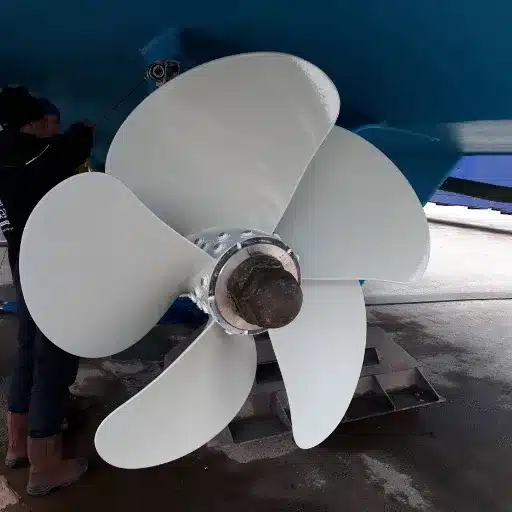
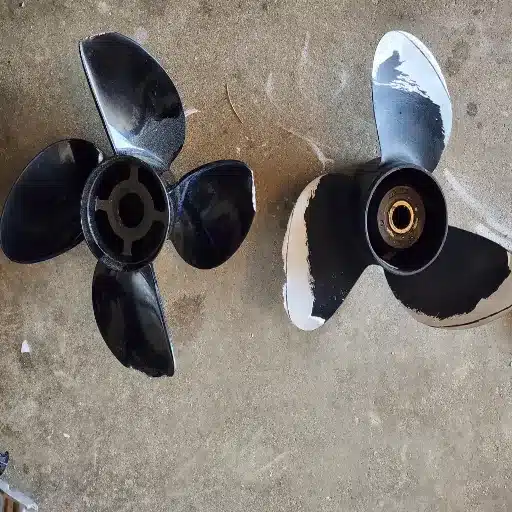
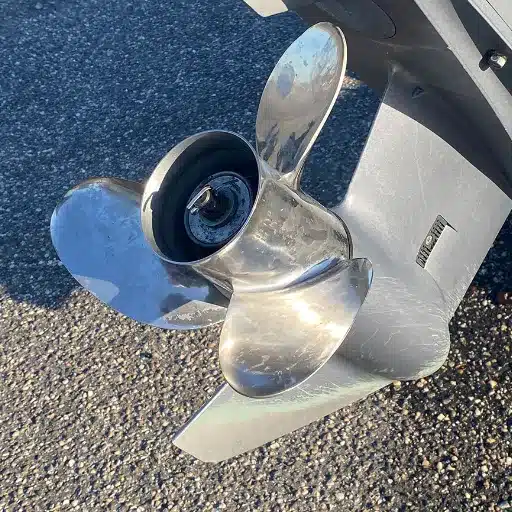
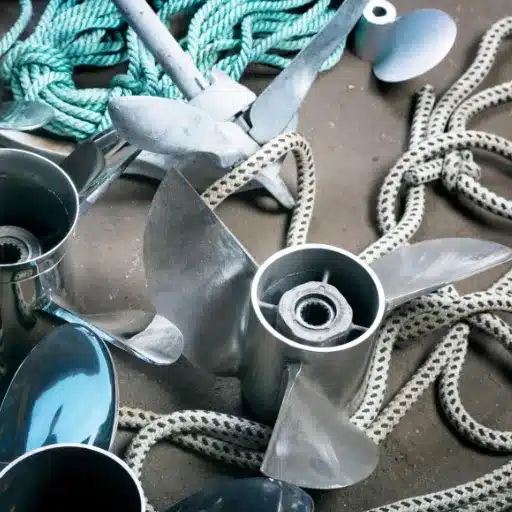
The best propeller for a pontoon boat is a 4-blade prop pitched 1 to 2 inches lower than a V-hull of the same horsepower would use, stainless steel if you load heavy or tow, aluminum if you mostly cruise light. Most pontoon owners run the factory prop and never realize they are leaving 3 to 5 MPH of top speed and 3 to 7 seconds of planing time on the dock.
Pontoons are not V-hulls. Their flat decks, high wind profile, and weight distribution punish the same props that work great on bass boats and runabouts. At Captain Marine, we have rigged pontoons and tritoons across every HP class from 60 HP lake cruisers to 300 HP tow-sport monsters. For the full propeller decision framework that covers every boat type, start with our boat propeller selection guide. This article gives you HP-by-HP picks, a size chart, and the math behind pontoon-specific prop selection.
Key Takeaways
- A 4-blade propeller is the best default for most pontoons because it planes faster under load and grips better in turns.
- Pontoons typically need 1 to 2 inches less pitch than a V-hull of the same HP due to higher drag.
- Stainless steel pays back its price premium in 1 to 2 seasons for heavy loads, tritoons, and tow boats.
- Tritoons can tolerate 1 to 2 inches more pitch than twin-tube pontoons because the third tube adds lift.
- Always run a WOT RPM test after any prop swap to keep your engine in its manufacturer-recommended range.
Why Pontoon Boats Need a Different Propeller
Drag and Lift Profile vs V-Hull
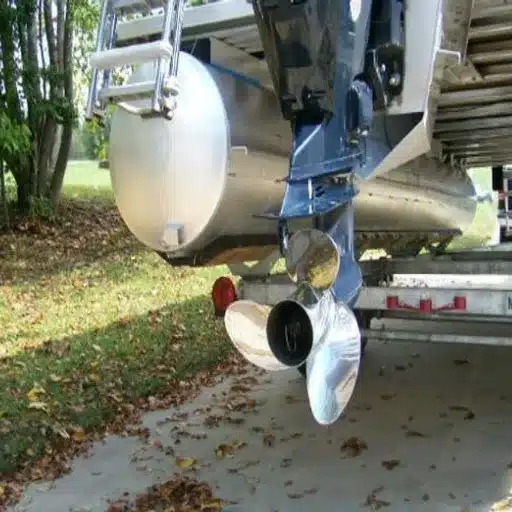
A pontoon hull sits on two or three round tubes. Unlike a V-hull that slices water and generates dynamic lift from its running surface, a pontoon pushes water out of the way. That blunt resistance means the engine works harder to get the boat moving, and harder still to hold plane under load. The factory 3-blade propeller that ships with most outboards was engineered for lighter, more aerodynamic hulls.
A pontoon also carries its weight differently. Passengers, coolers, and gear sit above the waterline, raising the center of gravity and increasing wind drag. The prop has to overcome all of that before the boat feels responsive.
Why Factory Pontoon Props Underperform
Most OEM pontoon props are conservative aluminum 3-blades in the 13 to 15 inch diameter range and 13 to 17 inch pitch. That combination works fine for a light dealer demo run with two people on board. It falls apart the moment you load six adults, a cooler, and a tube onto a 22-foot pontoon on a breezy Saturday.
The factory prop is also pitched for WOT RPM in the middle of the recommended range, not for the real-world load most pontoon owners actually run. That means the engine lugs at cruise, burns more fuel than it should, and struggles to climb on plane.
Single-Tube vs Tritoon (Triple Tube)
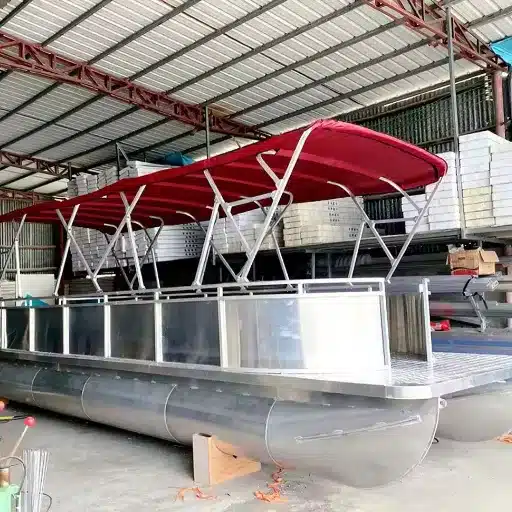
A standard pontoon uses two tubes. A tritoon adds a center tube, which changes everything. The third tube adds buoyancy, reduces hull drag, and lets the boat plane at lower speeds. It also tolerates a higher-pitch prop because the hull itself is already doing more of the lifting. If you own a tritoon, you can run 1 to 2 inches more pitch than a comparable twin-tube pontoon on the same engine without overloading the motor.
Direct Answer: What Is the Best Propeller for a Pontoon Boat?
The best pontoon boat propeller for most owners is a 4-blade stainless steel prop in 1 to 2 inches less pitch than the factory spec, matched to your engine’s WOT RPM range. Aluminum is fine for light cruising and budget-conscious owners. A 3-blade can work on small, lightly loaded pontoons under 90 HP. For tritoons and tow-sport setups, the 4-blade stainless advantage is even larger.
Blade Count: Why 4-Blade Wins for Most Pontoons
Hole Shot and Planing Under Load
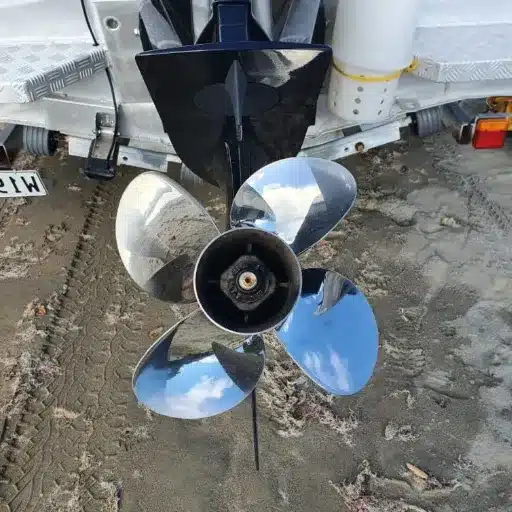
A 4-blade propeller adds roughly 20 to 30% more blade area than a 3-blade propeller of the same diameter. On a pontoon, that extra grip translates directly into a faster hole shot. Real-world testing and field reports from our rigging team show that a properly matched 4-blade can cut time-to-plane from over 12 seconds to under 7 seconds on a loaded 24-foot pontoon. Independent propeller tests at BoatTEST confirm that blade-area increases of 20% or more produce measurable hole-shot gains on pontoon hulls.
That difference is the gap between a boat that wallows and a boat that climbs. When you have a pontoon full of passengers and a wakeboarder waiting in the water, those seconds matter.
Smoothness at Cruise
A 4-blade also delivers a smoother ride at the 3,000 to 4,000 RPM cruise band, where pontoon owners spend most of their throttle time. The extra blade area reduces prop slip, which smooths power pulses and lowers vibration through the deck. For a family that spends four hours on a cruise on a Sunday afternoon, that smoothness is worth the upgrade by itself.
When a 3-Blade Still Makes Sense for a Light Pontoon
A 3-blade is not wrong for every pontoon. On a small 16-foot to 18-foot pontoon with a 60 to 90 HP outboard, lightly loaded, and used mostly for calm-water cruising, the factory 3-blade is adequate. It costs less, spins up to WOT RPM more easily, and keeps top speed slightly higher. For our full breakdown of when each blade count wins, see our 3 blade vs 4 blade propeller comparison.
Material: Aluminum vs Stainless Steel for Pontoons
Aluminum — Affordable, Sacrificial, Shallow-Water Friendly
Aluminum pontoon props cost $80 to $250, depending on blade count and brand. They are lighter, easier to handle, and sacrificial. If you beach the boat on a sandbar or clip a submerged stump, the aluminum blade bends or breaks instead of damaging the lower unit. That makes aluminum the right call for casual lake boaters who run shallow, load light, and do not chase performance.
The downside is flex. Aluminum blades flex more under load than stainless steel, which means less bite, slower hole shot, and slightly worse fuel economy at cruise.
Stainless Steel — Stiffer, Faster, Heavier-Load Ready
Stainless steel props cost $300 to $900 for pontoons. The material is 10 to 15% stiffer than aluminum, which translates directly into better bite, faster planing, and 3 to 5 MPH more top speed on the same hull. For a tritoon or a tow-sports pontoon, stainless is almost always the right upgrade.
Stainless also holds its pitch and balance longer. An aluminum prop that takes a few small dings over a season will develop vibration. A stainless prop tolerates minor damage better and stays smooth.
Cost vs Benefit Math for a Typical Pontoon Owner
If you load your pontoon heavy four or more times per season, tow tubes or skiers, or own a tritoon, stainless steel typically pays for itself in fuel savings and reduced engine strain within one to two seasons. For the full lifecycle cost breakdown, see our aluminum vs stainless steel propellers guide.
Pontoon Propeller Pitch: How to Get It Right
Lower Pitch for Pontoons — Why
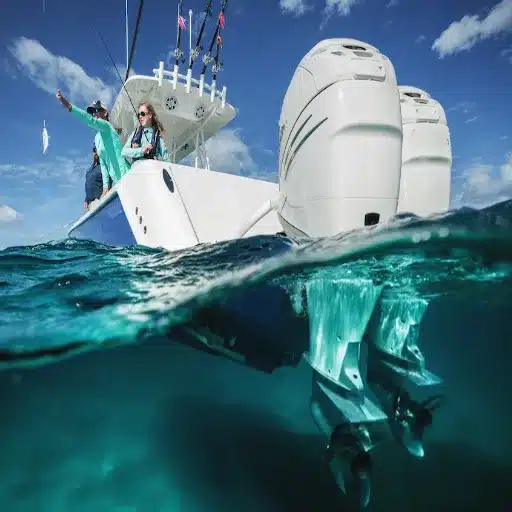
Pontoons run 1 to 2 inches less pitch than a V-hull of the same engine horsepower. The reason is drag. A V-hull generates lift and slices through the water efficiently. A pontoon pushes it. The engine has to spin the prop faster to overcome that resistance, which means you need less pitch to keep WOT RPM in the manufacturer’s recommended range.
Running too much pitch on a pontoon is the single most common mistake we see. The boat feels sluggish, the engine lugs, and fuel burn goes up.
The Pitch Rule: 1 inch = Roughly 200 RPM
As a rule of thumb, every 1 inch of pitch change moves WOT RPM by about 200. If your 150 HP outboard is supposed to run 5,500 to 6,000 RPM at WOT, and your current 17-pitch prop only hits 5,200 RPM, dropping to a 15-pitch prop should bring you back into range.
Pontoon Pitch Targets by HP Band
| Engine HP | Typical Twin-Tube Pitch | Typical Tritoon Pitch |
|---|---|---|
| 60 to 90 HP | 11 to 13 in | 13 to 15 in |
| 115 to 150 HP | 13 to 15 in | 15 to 17 in |
| 175 to 200 HP | 15 to 17 in | 17 to 19 in |
| 225 to 300 HP | 17 to 19 in | 19 to 21 in |
These are starting points. Always confirm with a WOT RPM test after installation.
Pontoon Propeller Size Chart by Engine HP
Use the chart below as your at-a-glance reference. Diameter and pitch work together, so stay within the ranges shown and test after installation.
| Engine HP | Typical Diameter | Typical Pitch | Blade Count | Best For |
|---|---|---|---|---|
| 60 to 90 HP | 11 to 13 in | 11 to 15 in | 3 or 4-blade | Small pontoons, light cruising |
| 115 to 150 HP | 13 to 14 in | 13 to 17 in | 4-blade preferred | Mid-size family pontoons |
| 175 to 200 HP | 13.5 to 14.5 in | 15 to 19 in | 4-blade | Large pontoons, light tritoons |
| 225 to 300 HP | 14 to 15.5 in | 17 to 21 in | 4-blade or 5-blade | High-performance tritoons, tow sports |
For a deeper dive on how diameter and pitch interact across all boat types, see our guide on boat propeller size.
Best Pontoon Prop Models (2026)
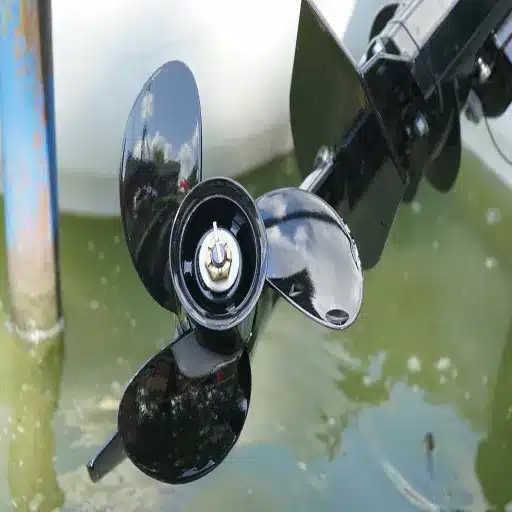
Mercury Spitfire X7
The Spitfire X7 is Mercury’s purpose-built pontoon prop. It uses a large-diameter, four-blade design with an aggressive rake to push heavy loads onto the plane faster. It fits Mercury, Mariner, and Yamaha outboards with the Flo-Torq hub system. Expect to pay $500 to $650. It is the default pick for 115 to 250 HP pontoon and tritoon setups, where hole shot is the priority.
Yamaha Talon GP
Yamaha’s Talon GP is a stainless 4-blade with a high-thrust geometry that matches Yamaha’s SDS hub system. It excels on 150 to 300 HP Yamaha outboards mounted to pontoons and tritoons. Expect $550 to $700. It is slightly more top-speed oriented than the Spitfire X7, which makes it a good fit for owners who split time between cruising and light towing.
Solas Amita 4 / Saturn / Rubex
Solas offers the best value play in pontoon props. The Amita 4 is a stainless 4-blade that performs close to the OEM premiums at roughly 30 to 40% less cost. The Saturn series covers aluminum 4-blades for budget upgrades. Both use the Rubex hub system, which fits most major outboard brands. Expect $250 to $400 for stainless and $120 to $200 for aluminum.
Michigan Wheel Apollo XHS
Michigan Wheel’s Apollo XHS is a stainless 4-blade with a broad cup and aggressive rake. It bites hard at low RPM, which is exactly what a loaded pontoon needs. It fits Mercury, Yamaha, Honda, and Suzuki outboards through the XHS interchangeable hub system. Expect $350 to $500.
Captain Marine Private-Label Picks
Our private-label pontoon props mirror the Spitfire X7 and Talon GP geometry at a lower price point, with the correct hub kit included. If you want the performance without the OEM markup, our rigging team can spec the exact diameter, pitch, and blade count for your hull and engine combo.
Tritoon vs Twin-Tube: How the Third Tube Changes Prop Choice
Hull Drag and Lift Differences
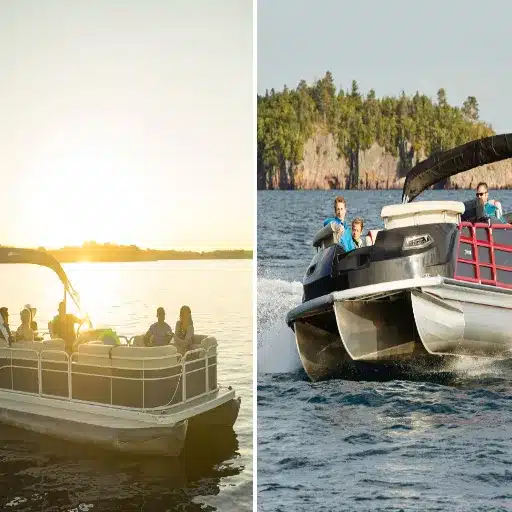
A tritoon adds a center tube, usually 19 to 25 inches in diameter, between the two outer pontoons. That center tube does two things. It increases buoyancy, which lets the boat carry more load without squatting. It also creates a partial planning surface, which reduces drag and lets the hull climb onto a plane at lower speeds.
The result is that a tritoon behaves more like a planning hull than a displacement hull. The prop does not have to work as hard to lift the boat, so it can tolerate more pitch without lugging the engine.
Why Tritons Tolerate Higher Pitch
On the same 150 HP outboard, a 22-foot twin-tube pontoon might run best with a 14-pitch prop. A 22-foot tritoon of the same length and engine can often run a 15- or 16-pitch prop and still plane quickly. The extra pitch gives back 1 to 2 MPH at the top end without sacrificing hole shot.
Twin and Triple Engine Tritoon Setups
High-end tritoons sometimes run twin outboards (twin 150s or 200s) or even triple engines. In those setups, each engine should run a standard pontoon prop, but the boat overall has enough power that 5-blade props become an option for extreme hole shot and towing. For most recreational tritoons, a single 4-blade stainless prop on one engine is still the sweet spot.
Real-World Pontoon Performance Case Studies
22-Foot Pontoon with 150 HP (Family Cruiser)
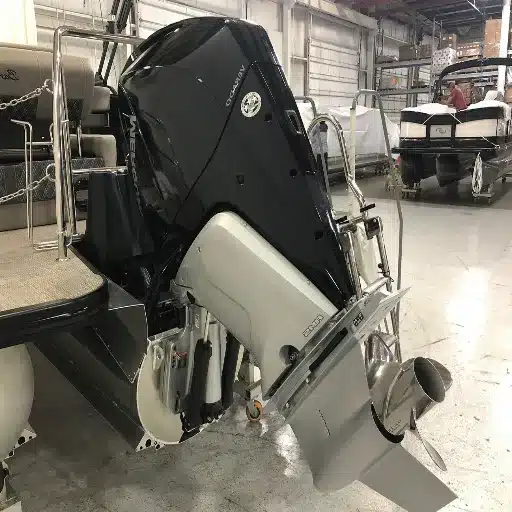
Lisa runs a 22-foot Bennington with a 150 HP Mercury on a Wisconsin lake. Her family of four cruises every weekend, and they tow a tube behind the boat two or three times per summer. The factory prop was a 14.5 x 17 aluminum 3-blade.
Her boat struggled to plane with the tube in tow and six passengers on board. Time-to-plane with a full load was about 11 seconds. Top speed was 28 MPH. We recommended a Mercury Spitfire X7 14 x 15 stainless 4-blade.
After the swap, her time-to-plane dropped to 6 seconds with the same load. Top speed climbed to 32 MPH. Cruise fuel economy at 3,500 RPM improved from 2.8 MPG to 3.2 MPG. She paid $600 for the prop and estimates the fuel savings cover about $80 per season. For her use case, the upgrade paid for itself in comfort and safety, not just dollars.
24-Foot Tritoon with 250 HP (Tow-Sports Setup)
Marcus bought a 24-foot Manitou tritoon with a 250 HP Yamaha for wakeboarding and tubing on a Tennessee reservoir. The dealer spec’d a 15 x 19 stainless 3-blade. The boat was fast at 42 MPH top speed, but the hole shot with a wakeboarder was sluggish. The bow rose slowly, and the engine labored until it hit 3,800 RPM.
We recommended dropping to a Yamaha Talon GP 14.75 x 17 stainless 4-blade. The lower pitch and extra blade area pulled the boat onto plane in 4.5 seconds instead of 8.5 seconds with a wakeboarder in tow. Top speed dropped to 39 MPH, which Marcus did not mind. The real win was the confidence that the boat would pull a wakeboarder out of the hole on the first try, every time.
20-Foot Pontoon with 90 HP (Lake Day Cruiser)
Jerry owns a 20-foot Sun Tracker with a 90 HP Mercury on a small Ohio lake. He cruises solo or with one passenger, never tows, and beaches the boat regularly on a sandy shoreline. His factory prop is a 13 x 15 aluminum 3-blade.
We advised him to keep the factory prop. A 4-blade would improve the hole shot marginally, but he never loads the boat heavy enough to notice. An aluminum blade is sacrificial against the sandbar, which matters more to him than the 2 MPH he might gain from stainless. His money was better spent on a spare aluminum prop to keep in the storage compartment.
How to Switch Your Pontoon Propeller (Step by Step)
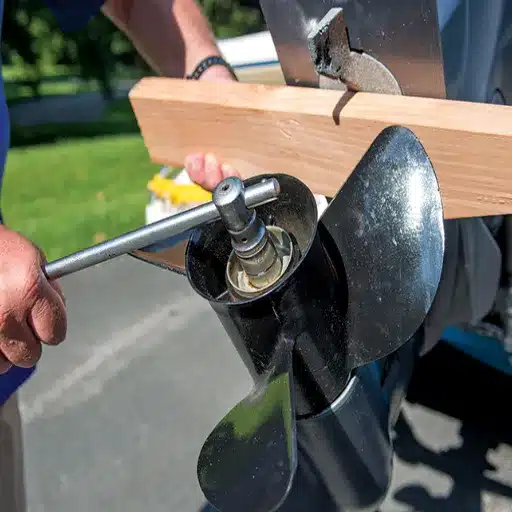
Confirm Current Pitch and WOT RPM
Before you buy anything, know where you stand. Run your boat at wide open throttle on flat water with a typical load. Record the peak RPM and compare it to the engine manufacturer’s recommended WOT range. If you are already at the top of the range, you have room to add pitch. If you are below the range, you need less pitch.
Choose Replacement Pitch (Drop 1 to 2 inches if Switching to a 4-Blade)
If you are moving from a 3-blade to a 4-blade of the same diameter, drop pitch by 1 to 2 inches. The extra blade area loads the engine more heavily, which pulls RPM down. A 4-blade in the same pitch as your old 3-blade will almost always lug the motor.
Hub Kit Compatibility
Most pontoon outboards use one of three hub systems: Mercury Flo-Torq, Yamaha SDS, or a standard rubber push-in hub. Almost all aftermarket props ship with the correct hub kit or offer it as an accessory. Captain Marine includes the matching hub kit with every prop we ship.
Run-In and WOT RPM Test
After installation, run the new prop through a break-in period of 15 to 20 minutes at varied throttle. Then load the boat to normal operating weight and run WOT for 30 seconds. Record peak RPM. If you are outside the manufacturer’s recommended range, adjust pitch by 1 inch and retest. This is the same protocol every professional rigging shop follows.
Common Pontoon Propeller Mistakes
Over-Pitching to Chase Top Speed
Pontoon owners see a big top-speed number on a prop spec sheet and assume more pitch is better. It is not. Too much pitch lugs the engine, strains the powerhead, burns extra fuel, and makes the boat feel sluggish at cruise. Match pitch to your WOT RPM range, not your speed dreams.
Buying the Wrong Diameter
Diameter and pitch work together. A 14 x 15 prop behaves differently from a 13 x 15. Larger diameter increases blade area and grip but also increases drag. On a pontoon, stick within the diameter ranges shown in the HP chart above. Going oversized can drop WOT RPM below the safe range.
Choosing Stainless When You Beach the Boat
Stainless steel is stronger than aluminum, which sounds like a benefit. If you regularly beach your pontoon on sand or gravel, that strength becomes a liability. A stainless prop will transfer impact force to the lower unit gears instead of bending. Aluminum is sacrificial. Beach often? Run aluminum.
Ignoring Counter-Rotation on Twin Engines
Twin-engine tritoons require one standard-rotation prop and one counter-rotation prop. If you accidentally order two standard-rotation props, the boat will pull hard to one side and fight the helm. Always confirm rotation direction before ordering for a twin setup.
Frequently Asked Questions
What is the best propeller for a pontoon boat?
The best propeller for most pontoons is a 4-blade stainless steel prop pitched 1 to 2 inches lower than a V-hull of the same HP. Aluminum is fine for light cruising and shallow water. A 3-blade works on small, lightly loaded pontoons under 90 HP.
What size propeller do I need for my pontoon?
Match diameter and pitch to your engine HP and hull type. Use the HP chart in this guide as a starting point, then fine-tune with a WOT RPM test. Most 115 to 150 HP pontoons run a 13 to 14 inch diameter with a 13 to 17 inch pitch.
Is a 3-blade or 4-blade prop better for a pontoon?
A 4-blade is better for most pontoons because it planes faster under load, grips better in turns, and runs smoother at cruise. A 3-blade is adequate for small, lightly loaded pontoons where cost and top speed matter more than hole shot.
Should I use an aluminum or stainless steel pontoon propeller?
Use aluminum for light cruising, shallow water, and tight budgets. Use stainless steel for heavy loads, tritoons, tow sports, and owners who want the best hole shot and fuel economy. Stainless typically pays back in 1 to 2 seasons for heavy-use pontoons.
What pitch propeller should I use for my pontoon?
Pontoons need 1 to 2 inches less pitch than a V-hull of the same HP. After installing any new prop, run a WOT RPM test and adjust until the engine sits inside the manufacturer’s recommended range.
Why does my pontoon struggle to plane?
Common causes include:
- Prop pitched too high for the load — Drop pitch by 1 to 2 inches and retest WOT RPM.
- Too few blades for the weight — A loaded pontoon usually needs a 4-blade instead of a 3-blade.
- Dirty or damaged prop — Even small dings and fouling reduce blade efficiency and grip.
- Excess weight on board — Move heavy gear and passengers toward the center of the deck.
- Hull needs cleaning — Algae and barnacles on the tubes add drag that props cannot overcome.
Start by checking prop pitch and blade count against the recommendations in this guide.
Will a new prop make my pontoon faster?
A properly matched stainless 4-blade can add 3 to 5 MPH of top speed and cut planing time by 3 to 7 seconds compared to a factory aluminum 3-blade. The biggest gains come on loaded boats and tritoons.
What is the best prop for a Tritoon?
Tritoons benefit most from a stainless 4-blade in a pitch 1 to 2 inches higher than a comparable twin-tube pontoon. The third tube adds lift and reduces drag, so the engine can handle more pitch without lugging. High-HP tritoons used for tow sports may even benefit from a 5-blade prop.
How much does a pontoon propeller cost?
Aluminum pontoon props run $80 to $250. Stainless steel pontoon props run $300 to $900. Premium OEM-specific models like the Mercury Spitfire X7 and Yamaha Talon GP run $500 to $950.
The Bottom Line
Choosing the right pontoon boat propeller is about matching the prop to the hull, the HP, and the way you actually use the boat. A twin-tube family cruiser with 150 HP and six regular passengers needs a very different prop than a solo lake-day pontoon with 90 HP. Get the blade count right first, then match pitch to your WOT RPM range, and choose material based on load and budget.
Key takeaways:
- 4-blade is the default for most pontoons because of load, drag, and hole shot
- Drop pitch 1 to 2 inches versus a V-hull of the same HP
- Stainless pays back on heavy loads, tritoons, and tow boats in 1 to 2 seasons
- Tritoons tolerate a higher pitch because the third tube adds lift
- Always test WOT RPM after any prop swap
Still not sure which prop fits your pontoon? Send us your boat length, engine year, and HP, current prop markings, and typical passenger load. The Captain Marine rigging team will recommend a specific diameter, pitch, blade count, and material. Browse our propeller catalog or contact our team to get your pontoon dialed in for the 2026 season.